 |
SOCIAL CARE WITH CHILDREN AND FAMILIES Unit 1: The Social and Political Context of Social Care with Children and Families UNIT OBJECTIVES After completing this unit you will be able to:
Session One
SESSION OBJECTIVES
After completing this session
you will be able to:
INTRODUCTION
Before you start to learn about
families, you need to examine the idea of the family. There is little
agreement as to what a family is and to what the term refers.
WHAT DOES THE TERM ‘FAMILY’
MEAN?
When we talk of the family, are
we talking about what is real or what the majority of people in society
believes the family ought to be? You will come across this question time and
time again while you are studying this module. Briefly jot down the
feelings and thoughts which spring to mind as you ponder on the term
‘family’.
Comment
Like most people, you
probably found the idea of the family an emotive one, perhaps bearing
little resemblance to reality. If you are honest with yourself, you will
recognise some of the following which usually accompany notions of the
family:
assumptions and prejudices misinformation political manipulation nostalgia or desire. ‘Family’ is a notion that
carries with it great expectations that cannot always be fulfilled, and
which may ultimately disappoint.
I could have called this session ‘So you think you know what a family is!’
It is the beginning of a hard, critical examination of our own and others’
understandings of the family, so that you can be better informed in your
work with families. To start with, it would be
useful to consider what you think a family is. I am going to ask you do
this in two ways.
Task 1. On a clean sheet
of paper, draw your family using any symbols you wish.
Task 2. On the basis of
this drawing, write down a definition of what you think a family is.
Don’t worry if, when you
get down to writing the definition, you wish you had done the drawing
differently.
Limit yourself to about 15
minutes on your drawing, and please do not attempt to write a definition
of the family before you do your drawing.
Comment
Did you find that your
definition fitted exactly with your drawing? Or did you find that when
thinking about it, your definition was much wider, or more narrow than the
idea in your head when you drew your family?
Let’s now look at how other
people might perceive a family.
DEFINING FAMILIES
In order to come up with a more
general description of the family, we can and should take account of the
great range of family forms.
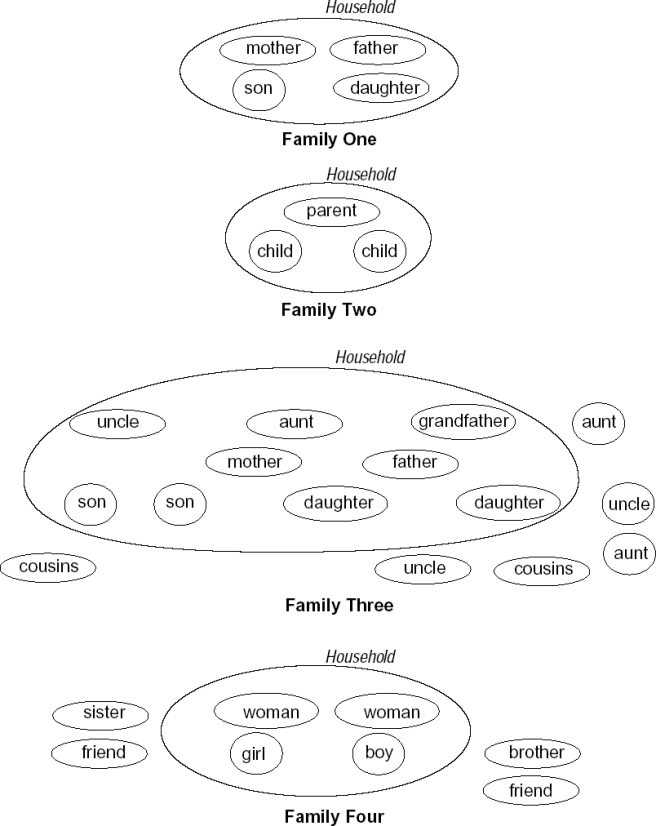
Look at the four different
diagrams of families below. All of these are valid, but some are
more limited than others in the ways they show a family.
What do they tell you
about different ways of perceiving families? For each diagram, make a few
notes on what it tells you about the family.
Family One shows a family
as:
Family Two shows a family
as:
Family Three shows a
family as:
Family Four shows a family
as:
Diagram A: Family
structures
Comment
It is important to look
critically at our own perceptions of families, and at definitions arising
from the work of researchers and commentators. We will examine each family
diagram in turn.
Family 1 is how many
people might see their families, but it is rather limited. It shows a
nuclear family, equating the household to the family. This concept of the
family is the basis of much social policy and traditional thinking.
Murdock defined the family as
‘a social group characterised by common residence, economic cooperation
and reproduction. It includes adults of both sexes, at least two of whom
maintain a socially approved sexual relationship, and one or more
children, own or adopted, of the sexually cohabiting adults.’ (Murdock G,
quoted in Morgan D H J, 1975, Social Theory and the Family,
Routledge and Kegan Paul, London.)
You may want to criticise
this particular definition. It fails to recognise family forms other than
those embracing a mother, a father and 2.5 children. It can be viewed as
sexist, heterosexist and racist. However, it may still be how many people
think of the family. Another example of a limited definition is that given
by the Rapoports, who suggested that families are ‘intimate domestic
groups made up of people related to one another by bonds of blood, sexual
mating or legal tie.’ (Rapoport R and R, in Rapoport R N, Fogarty MP and
Rapoport P, 1982, Families in Britain, Routledge and Kegan Paul,
London, p 475.) This view of the family is reinforced in books –
particularly children’s books – and the media.
Family 2 is another
family arrangement, where one parent alone is looking after the children.
This is an important – and common – variation of the nuclear family
represented by Family 1. Many families choose this arrangement. Other
families accept or put up with the situation through force of
circumstances. The lone parent could be a woman or a man.
Family 3 is another way
in which people might see their family. It is much more all-embracing.
This family is more than just one household. It is a constellation of
those people with whom one has a relationship whether by blood or
marriage. The household itself may include more relatives than would be
found in the nuclear family in this example.
Family 3 fits with a more
recent description of the family: ‘When we say "family" in the Black
community, it is not confined to a husband, wife and children living in
isolation; we have a more complex notion of the family which includes more
distant relatives and close standing friends.’ (Ahmed, S, Cheetham J and
Small J, 1986, Social Work with Black Children and Their Families,
Batsford, p 70) We shall discuss Black perspectives on the family more
thoroughly in Session Six.
Family 4 represents
another family form, where two women or two men live together with their
children, and are supported by a set of close relatives and special
friends. These two adults may have come together from friendship, out of
economic necessity, or they may be lovers.
There are many other family
arrangements, which are born out of choice or necessity.
Briefly note any other
arrangements with which you are familiar.
Comment
You might have thought of:
a single person living
alone who sees her or his family as including close relatives, close
significant others, and a number of unknown, but real relatives. a commune made up of
several family groups who live together and share resources and caring
responsibilities, often because of a shared interest or ideology. In your work with families it
is important not to be limited by conventional notions or your own
experience of families.
THE FAMILY AS A DISPUTED
NOTION
So we have seen that the term
family means different things to different people. It is a disputed notion.
When people refer to their family they may be referring to any of the
following:
those who live together in
one house, in other words, members of a household, whatever the legal
relationship between them those who are closely related
by blood or marriage, even if they do not live together in the same house;
in other words kinship all those with whom one
person can trace a relationship people with whom a person has
emotional ties. So although there might be some
shared understandings about the notion of the family, there are far more
differences between peoples’ perceptions of it. Many different ingredients
can make up a family and there are also many different types of families. This activity will give
you an opportunity to do a little research and extend your own work on
ideas of families. Keep your notes and answers with the rest of your work
on this session. Ask some people you know
and/or work with what they think a family is. Write down the different
things they mention. Summarise your findings
in (1) by making a list of the ingredients of a family, as most people
see these. When you have done your
research, organise these ingredients into groups representing different
views on the family. Perhaps one group could be a narrow view and the
other a broader view of what families are. Now reflect on what you
have learned in this session. Briefly note how your views of families
have changed, if at all. How will your work in this session affect your
work with families? SUMMARY
There are many different views
of what makes a family. Some commentators believe that differences in views
about what constitutes a family are relatively recent. They believe there
was a time in the past when things were much more straightforward.
The next session critically
examines myths and realities about families in the past.
SESSION OBJECTIVES
After completing this session
you will be able to:
INTRODUCTION
In order to understand the
present, it is useful to have an understanding of the past. We often hear
people saying how terrible it is that the influence of the family is
breaking down or that life would be so much better for everybody if we could
get back to the traditional family. Often people look back to a time when
there were better behaved younger people and higher educational standards.
The past seems to be often seen through rose-coloured spectacles. As social
workers, we need to ask ourselves what historical research actually tells us
about the past.
VICTORIAN FAMILIES
We begin this session by
looking at some of the myths connected with the Victorian family, so often
seen as the high point of family values in Britain. ‘If we could only get back
to the Victorian ideals of family life, then we would not have the
problems we are having today!’
The above statement could
come from any politician, any tabloid newspaper editor, any spokesperson
of the establishment, when decrying the failures of modern family life.
When politicians and
others talk about the need to return to Victorian family values, they are
referring to a rather nebulous idea which bears some investigation. Place
a tick by any of the following which you believe were valued in the
Victorian family.
freedom stability respect for authority justice discipline honesty hard work equality faithfulness in marriage thrift Comment
To some, the term ‘Victorian
family values’ is a coded language for values such as:
respectability stability discipline thrift self-help respect for authority hard work faithfulness in marriage.
To understand the meaning of Victorian values, we need to examine what is
behind emotive phrases, and to question their validity. It seems likely that
these politicians and others are harking back to something that did not
quite exist in the ways which are implied. Let’s look at some of the
historical facts.
A CRITIQUE OF VICTORIAN
FAMILY LIFE
There never was one common
family form in the hierarchical Victorian society. When people praise
Victorian family life with nostalgia, they are probably referring to the
family life of the middle classes. Despite this, or perhaps because of it,
Victorian values are part of a useful myth which supports certain political
ideologies.
Let’s take a more critical look
at Victorian family life and Victorian values. Read the extract at the
end of this workbook from a New Society article: ‘How Much Has the
Family Changed?’ by Michael Anderson, 27th October 1983.
Pay particular attention
to critical comments in the article on values such as:
stability sexual morality. For each of these ideals
consider the following questions:
What reasons are given
for the fruitlessness of harking back to past values? What factors in the
present might prevent behaviour from the past being relevant today? What problems are there
in quoting such values as a guide for people’s behaviour today. Comment
As you have probably
discovered, Victorian values are problematic notions. All these
high-sounding phrases are not necessarily rooted in reality, or at least
not in everybody’s reality. Victorian society was divided by class in a
more obvious way than British society is today, and such values were not
necessarily shared throughout society. There was also a certain hypocrisy
involved in the way respectable people had double standards in relation to
morality. These people often criticized promiscuity in public, while
indulging in it privately.
Let’s look in more depth at the
ideals of stability and sexual morality.
Stability
There are two main points about this notion, which help us to become
aware of the contradictory nature of myths. First, if stability means a
steady, unchanging state of affairs, the situation might be better described
as stagnation, perhaps maintaining the worst as well as the best
characteristics of the society.
Secondly, we need to ask how
stable Victorian society was in reality. Contrary to popular belief, the
nineteenth century was also a period of considerable social upheaval,
political conflict and economic change.
The extract in Activity 6 above
raises questions about the real stability of the Victorian family. Often
babies, children and one or both parents died prematurely and there were
uncounted broken marriages. In many working-class families, surviving
children had to leave home early to make a living. This often had adverse
effects on their own health and limited opportunities for education, and
could not have done much for the stability of their home life.
Sexual morality
We need to question the belief that the Victorians were somehow more
moral than people of today with regards to sexual behaviour. According to
its own definition of morality, Victorian society was not a particularly
moral place. Prostitution was widespread, often involving children,
double-standards and illegitimate births. Many charities were involved in
rescuing children from these and other social ills, such as child crime and
immorality. These were usually the children of people regarded as deserving,
that is, those not corrupted by illegitimacy or irredeemable poverty.
The double sexual and moral
standards of Victorian middle and upper class society made it possible for
the establishment and its supporters to behave in one way and at the same
time to decry the failures of the poor and those they wished to define as
depraved. Such hypocrisy in relation to morality is a useful weapon in the
arsenal of the rich and powerful to enable them to protect what they have.
This is as true today as it was in Victorian times.
Men’s sexual needs were met,
often in ways that were condemned, and yet the sexuality of women was all
but denied. This is another example of the way Victorian society was divided
and oppressive.
Conclusion
So it seems that Victorian society was neither as stable or as moral as
current mythology might have us believe. Even if this was not the case,
there have been many changes which would make our adherence to such values
irrelevant if not impossible. Increased social and physical mobility, as
well as improvements in transport and communications, mean that whole
families move together rather than expecting one or two people to leave home
in order to support a family. People are exposed to a far greater range of
ideas and possibilities than were many people in the Victorian age.
Developments in medicine and science resulting in birth control and higher
standards of health have given people the opportunity for more choice in
their sexual activities. The feminist movement has forced people to
recognise that women have needs and rights as well as men. These are just a
few of the things which make our society very different from that of the
Victorians. It is particularly important to realise that much of what is
portrayed as Victorian Society was simply a veneer on what was in many ways
a rotten foundation. Ask some people you know
what they believe families were like in the past. Make notes of what they
mention, sort these out into those you believe to be myths and those you
believe to have some truth in them.
Do some research of your
own into family life in the past. You may like to carry on looking at
Victorian times, or you might prefer to look at another age in history.
You might like to concentrate on one particular aspect such as children,
women, health, work. Try to find out whether the myth fits the reality –
or not. Take some time now to
reflect on what you have learned. How do modern realities of family life
compare with both Victorian myth and Victorian reality or with other,
perhaps mistaken ideals of the past?
What are the implications
of what you have learned for your own work with families?
SUMMARY
Victorian family life was based
on a patriarchal system, in which men ruled, sometimes through fear and
often, it seems, through violence. It was a society driven
by gender and class division, where those with power and influence made sure
that the status quo was maintained. Children often were subjected to harsh
treatment at home and long hours of labour if at work. In general, they were
expected to be seen and not heard. Those who call for a return to the values
of Victorian family life may appear to be calling for positive, sensible
qualities. But perhaps they are seeking to bring back to family life
division and oppression, where people, especially women and children, have
little or no status or value and where key values of freedom, justice,
honesty and equality would have little room.
There are many myths about
family life in the past as well as those of the virtuous Victorian family.
It would seem from our exploration of the Victorian family that mythical
golden ages of the past are not based on historical evidence. There really
was no golden age in the past.
Session Three SESSION OBJECTIVES
After completing this session
you will be able to:
INTRODUCTION
We can often gain a fuller
understanding of the meaning of our life in the present and in our own
culture by comparing it with the past and with other cultures.
This session examines:
different experiences of
childhood in different cultures and different ethnic groups, particularly
in relation to racism in the past in Britain contradictions involved in
childhood how these factors may impact
on our work with children and families. EXPERIENCES OF CHILDHOOD IN
THE PAST
It is not easy to define a term
like childhood. Childhood has become taken for granted in many societies. It
is difficult to imagine not having a period of life called childhood.
However, the concept of childhood is a fairly recent phenomenon. Our
grandparents, when they were children, had very different experiences of
childhood from today’s children. How would you describe
‘childhood’? Spend a few moments jotting down some ideas before
continuing.
Comment
Many people think of
childhood as a period of dependency when young people have a completely
different status from adults. Children are not regarded as full members of
society and may be seen to have few or no rights of their own. Children in
general are controlled by adults. Other people may see childhood as a
period of innocence, the best time of your life.
I would now like you to do
some simple research into childhood in the past in Britain.
You can gain a historical
perspective on childhood by asking older relatives, friends or
acquaintances about their childhood. How were they looked after as babies
and toddlers? What did they eat? What sort of games did they play as
children? How were they dressed? What sort of schooling did they have? At
what age did they start work? What sort of relationships did they have
with their parents and with their sisters and brothers?
You can ask many other
questions to give insight into experiences of childhood. As you talk and
listen you may find people will give answers to questions you never
thought of asking.
There are also a number of
books that may provide you with some insights into childhood in earlier
times. For example, read any novel of Charles Dickens, such as Great
Expectations.
When you have finished
your research, spend some time thinking about what it would have been like
to be a child in another era as compared with being a child in Britain
today. Then write up your findings – you may like to do this in the form
of a diary of a child from the age you were investigating.
Comment
If you have never looked into
the past, you probably found your research quite revealing of the ways in
which children have lived in other times. For example, in Victorian and
Edwardian Britain, childhood did exist, but for a shorter period.
Mortality was very high, particularly among poor people. Childhood was
often cut short as a result of serious childhood illnesses, such as
diphtheria, measles and whooping cough, all made worse by overcrowded,
poor housing. Children left school and went to work at 13, 14 or 15. They
often had to work in between attending school, or perhaps instead of
school, so as to supplement a low family income. Nowadays, many young
people work after school, but more often than not the money they earn is
their own.
Perhaps you were able to get
a sense of how children played in the past. Was it really more carefree?
Certainly children had to make do with the simple things in life, and
maintained their traditional games. In the cities and towns children
played on the streets, and there was a certain street culture particular
to children. The more wealthy children played in nurseries and gardens.
They probably did not have the freedom from adult influence that was
enjoyed by working class children.
Life was hard for many
children. Abusive physical punishment was the norm, and although emotional
and sexual abuse within the family took place, it was not exposed as it may
be today. It was not acceptable for such problems to be made a public issue
even by social reformers. For instance, Beatrice Webb left it to a footnote
in her autobiography to let it be known how prevalent incest and ‘the
violation of little children’ were in the overcrowded homes she researched
for Charles Booth’s survey into poverty (Beatrice Webb, 1971, My
Apprenticeship, Penguin, p 234).
The experience of childhood was
very different for the children of rich and the children of poor people.
Class differences were more clear-cut than they are today.
CHILDHOOD AND THE INFLUENCES
OF BLACK CULTURES
Black people have lived in
Britain for many centuries, in some parts living freely within the
community. However, in some places Black children were seen as objects of
curiosity or as legitimate targets for abuse by White people. During the
twentieth century Britain has become much more multi-racial and
multi-cultural. This has had a great influence on the experience of
childhood and our perceptions of childhood. In recent years Britain
has moved away from a mainly White, predominantly Christian, mono-culture,
to a situation with a variety of cultures, which can best be described as
pluralistic.
List those positive
influences on children and childhood which our multi-cultural society has
already provided, or could provide.
Comment
If you live and work in a
multi-cultural city or town, this task may not have been too difficult,
because the evidence of positive contributions of different cultures will
be around you. All of us in multi-cultural Britain will have some evidence
of the positive influences of different cultures through the media and in
our daily lives.
Some aspects of Black
cultures (Asian, African-Caribbean and Oriental) have already had a
positive impact, particularly Afro-Caribbean music and dance, and the
Asian food and clothes with which many children have become familiar .
Some aspects have made more
of an impact in some parts of the country than in others. Children now
have the benefit of seeing and in many ways sharing the experience of
different religions and cultural festivals, games, art and music, food,
costume. People of many different races and creeds are part of school and
social communities, offering children the chance to get to know and accept
the whole variety of different cultures and norms.
A developing awareness of the
experience of childhood in Black communities provides the opportunity to
see:
the ways in which children
from different cultures relate to their families and to people in
authority how they try and live up to
the expectations and traditions of their religion and culture how important their community
is to them how they are able to speak
and understand different languages. Some people argue that the way
forward for society is for children to develop this awareness, and not only
to accept but also to value differences.
This is an important point for
social workers, representing a significant step towards anti-racist social
work practice. From your own experience
and knowledge, write a short paragraph about what you think is the most
significant difference in Britain between White children’s experiences of
childhood and Black children’s experiences of childhood.
Comment
You could have considered a
number of differences. Perhaps the most significant one is the day-to-day
racism that Black children in this country experience, sometimes even at
the hands of White children. While Britain is a true multi-cultural
society with a population consisting of many different ethnic groups,
Britain will not be a true multi-cultural society until Black people,
including children, can live their lives free from discrimination,
prejudice and oppression by the White majority.
THE CONTRADICTIONS OF
CHILDHOOD
In the last part of this
session, we will examine some commonly made statements about childhood and
children. The following are brief
statements about childhood. They are not as true as they may first appear.
They all have a ‘but’ side. They may have many ‘but’ sides. Complete the
‘but’ sides(s) as you see them, and as fully as you can, to the following
statements.
Childhood is a time for
play, but … Comment
You may have found that there
were a lot more ‘buts’ than you had anticipated. Here are some of my
thoughts.
Childhood is a time for play,
but we should not underestimate the value of play as a preparation for
work. There may be elements of work and play in the activities of
children. It may be valuable in helping children take some responsibility
in and out of the home if they help with household tasks appropriate to
their age, which don’t exploit them. Sexism can also be tackled to some
extent by the sort of toys with which we encourage our children to play,
or the tasks in and around the home with which we ask them to help. We can
also challenge racism by providing toys and other play resources that
encourage children to be aware of, accept and value differences.
Childhood is a time of
innocence, but it is difficult, if not impossible, to protect children
from the media and commercial influences around them, which encourage them
to grow out of any innocence at an increasingly early age. At what age is
it acceptable for children to have boyfriends or girlfriends? Enabling
children to grow up involves a balance between treating them protectively
and liberating them by recognising their sexuality, and providing them
with the information and guidance they need.
Children are best brought up
in the family, but some families do not encourage the development of
the child, and may even hinder it. Children need the security that comes
from a loving family life, but they also need other positive influences
and experiences, whether in the extended family, the community, the
school, or with their own friends.
Childhood is a time for
growth and development, but we need to learn to recognise where a
child’s development is being impeded. This can be the result of poverty,
prejudice, lack of opportunity, lack of positive people to identify with,
or poor care.
Children are valued in our
society, but the resources for positive child care for every child are
not always provided and facilities and services for children are often the
target of cuts in central or local government expenditure. Children are
still living in poverty and deprivation. Children are still seen by some
carers as their belongings, with whom they can do what they will. On the
other hand there is a tendency in some families, encouraged by the media
to centre their whole life around their children, and in doing so invest
their children with inordinate power.
In this activity we may have
seen some of the contradictions inherent in our perceptions of childhood,
and in doing so recognise our own, and also society’s, ambivalence about
children. Draw up a table showing
some of the differences between childhood in the past and childhood today.
Draw up another table
showing some differences between childhood in different contemporary
cultures. Think about the experience
of childhood of White children and Black children in this country. What
contribution can you make as a social worker to counteracting racism? SUMMARY
This session has examined the
idea of childhood and how its duration and character varies between cultures
and in different historical periods. There has been a tendency for the
period of childhood gradually to lengthen in modern industrial societies.
The session has also
highlighted some of the benefits and some of the difficulties for children
and their families. The diversity of ethnic groups in Britain, each with its
own culture, and the inequalities of wealth and class, lead to many kinds of
childhood rather than just one childhood.
Session Four
SESSION OBJECTIVES
After completing this session
you will be able to:
INTRODUCTION
There are many dimensions of
inequality between families. This session examines inequality in wealth and
income. It focuses on poverty. All the different dimensions of inequality
are related to each other and poverty seems to be a root reason for
disadvantage. Nevertheless, there are other reasons why families have
different experiences and their members have different life chances. There are many differences
between families which may contribute to inequality. Make a list of as
many differences you can think of.
Comment
You might have thought of:
one-parent and two-parent
families families at different
stages of their life cycles, (for example, families with young children) families with more children
and families with less children families in different
geographical areas of Britain White families and Black
families working-class families and
middle-class families. WHAT IS POVERTY?
In this unit we are beginning
to recognise the ambiguity of many terms in common use. Poverty is a term
which means different things to different people. What does the term poverty
mean to you? Complete the sentences below.
When I talk about a poor
family, I mean the family is…
Real poverty is indicated
by…
Comment
Completing these sentences
should have helped you to explore what you mean by poverty. Perhaps you
have come up with statements about lack of sufficient income, or below
average income. These would suggest there is an absolute standard of
poverty. This would mean that if people fall below a certain income level,
they are living in poverty.
The idea of subsistence level
is one particular absolute standard of poverty, which has much credence
among policy makers. A subsistence level would be based on the average
cost of food for a family and the minimum cost of clothing, fuel and
household sundries, but it would not include rent, which would be counted
extra. This would provide a family with the means to exist. The level of
income support is fixed by this sort of calculation. People who fall below
this level of income will be in poverty.
To understand how
problematic such a basis for defining poverty is, we need to think about
what is missing from this calculation. Let’s think about the following
scenario.
An MP caused uproar in the
House of Commons, when he criticised those in his own party and in the
Opposition who are calling for a large increase in the level of income
support for families. ‘The Government will not do anybody any good by
throwing more money at people, and making them even more dependent on the
State. People need to learn how to manage their income, and not waste it
on things they do not need.’ The MP then proceeded to outline how he had
spent the last fortnight, successfully living on the same income available
to a single person on benefits.
Why do you think this MP’s
argument is misleading? List the problems associated with his attempt to
prove from his own experience that income support levels are adequate.
Comment
This MP, and others who think
along the same lines, could have no possible feel of the reality of living
at subsistence level just by trying it for a few weeks. Here are some of
the problems with his argument.
It doesn’t take into
account the cost of bringing up children. Poverty is rarely a
short-term state; it is more often long-term drudgery. Good management of
resources may be possible over a period of a couple of weeks, but what
happens when clothes or shoes need replacing or when there is a crisis
demanding money people do not possess? What happens if cheap
foodstuffs are not available, or people don’t know how to make cheap
foodstuffs into palatable meals? The stress and monotony of
living in poverty can make people’s dependence on nicotine and alcohol
more difficult to break. What happens if people are
living in poor housing which is expensive to heat? The children may want the
expensive things their friends have. So it is too simplistic to
define poverty in terms of an absolute standard. It bears little resemblance
to the reality of poverty for many families. It doesn’t take into account
the different resources that a family may start with, the public services
that are available which affect their quality of life, and the real cost of
living for families.
RELATIVE POVERTY
The statements you made in
completing the sentences in the first activity of this session may have
indicated that you see poverty as relative rather than as absolute.
Peter Townsend has been the
main proponent of this view with his notion of relative deprivation.
Following extensive research of both the conditions of people with low
incomes and the expectations of what resources people should have, he argued
that poverty should not be measured by an absolute standard, but by the
relative conditions and expectations of other people. Therefore, people can
be relatively deprived in comparison to others.
In 1979, Townsend published his
book in which poverty is compared to the classic poverty surveys of Charles
Booth and Seebohm Rowntree at the end of the nineteenth century. Here is
Townsend’s definition of poverty.
Individuals, families and
groups in the community in the population can be said to be in poverty
when they lack the resources to obtain the types of diet, participate in
the activities and have the living conditions and amenities which are
customary, or at least widely encouraged or approved, in the societies to
which they belong. Their resources are so seriously below those commanded
by the average individual or family that they are, in effect, excluded
from ordinary living patterns, customs and activities.
(Poverty in the United
Kingdom, 1979, Penguin, p 31)
General living conditions and
social expectations about the quality of life alter from generation to
generation, so that what is experienced as poverty nowadays would be very
different from what was experienced by our grandparents or even by our
parents. For example, if everybody around you has a television and you
cannot afford one, then you can be seen as relatively poor because you do
not fulfil society’s expectations about what you should properly possess.
Moreover you and your family are deprived of experiences that could be
useful, if not essential, for day-to-day conversation with others.
Of course, you may have decided
on principle not to have a television in your home. You may be in a position
to choose, whereas one of the characteristics of relative poverty is the
lack of choice available. The poorer people are, the fewer choices they have
in life. For some poor people the only choices they have are difficult
dilemmas, such as whether to pay a bill or to buy food for the children.
Whichever way they decide, they are the losers.
Townsend put forward a view of
resources which is wider than income alone. He also included other resources
such as employment-based benefits in kind. Such resources are distributed
unequally in different parts of the country and to different groups of
people. Clearly unemployed poor people will not get any employment-based
benefits such as subsidised canteen meals, or even less so, meals on expense
accounts. Low-paid workers do not get the perks available to their
higher-paid bosses. One argument is that the more you earn, the less you
have to pay for.
It is also becoming clearer
that poor families rely on locally accessible, public services in the
community such as play facilities. Cuts in such services deny key resources
to poor families, and they will be disproportionately affected by such
losses.
THE EFFECTS OF POVERTY ON
FAMILY LIFE
Now we have examined what
poverty is, we will explore what it is like actually to live in poverty. We
may or may not have experienced being poor at some time in our lives, but
certainly as social workers working with children and families we will come
across many people living in poverty.
People’s expectations are
rising rapidly. Whereas twenty years ago it was relatively unusual for
people in this country to have a washing machine, now it is much more the
norm. Similarly, almost everyone now has a television. It is so much a part
of our culture that it is difficult to imagine how someone could really take
part in everyday conversations without having at least some knowledge of
television. Many children today expect to have computers and computer games
which are run through televisions.
Children of low-income families
are likely to be denied new clothes and may not be able to afford to go out
with their friends. They are unlikely to be able to afford more middle class
pursuits such as music lessons, trips to the theatre or dining out, all of
which enrich children’s experience. They may not feel comfortable inviting
school friends round to a small house in which perhaps they share a room
with several brother and sisters. They will inevitably feel different from
their school friends.
The most effective way of
understanding what relative poverty means is to ask people in this situation
about their own experiences of not having what others have, and how they
deal with this difficult situation.
Discuss with someone you
know, or spend ten minutes or so considering by yourself, what other kinds
of items and experiences the children in low income families might be
deprived of relative to those children in families with moderately high
incomes. Consider how this deprivation will affect the children.
SUMMARY
In this session you have
studied poverty as an example of inequality between families. Poverty
impacts on family life in an extreme way and adversely effects the life
changes of family members. To be poor is to be disadvantaged. Equally
important as inequalities between families are the inequalities
within families, which are considered in the next session.
SESSION OBJECTIVES
After completing this session
you will be able to:
INTRODUCTION
Just as there are different
dimensions of inequality between families, there are different dimensions of
inequality within families. Age is one of these dimensions. Parents have
power over their children. Adult children often have power over their
parents. Older sisters and brothers can have power over their younger
sisters and brothers. Ability can be another dimension of inequality in
families. For example, a family member with a disability can be exploited by
other members.
This session focuses in
particular on gender as one basis for inequality within families.
POWER AND RESPONSIBILITY
WITHIN FAMILIES
If the family reflects society,
as it is often suggested, and if society is unequal, then we would expect to
discover some inequality in the distribution of resources and power in the
family. Let’s first examine how power is shared and responsibilities are
allocated within families. Think of a family you know
well – it could be your own. Then answer the following questions Who makes the decisions
in the family? Who disciplines the
children? Who controls what is
watched on the television or listened to on the radio? Who does the washing up? Who does what for whom
and why? (This is a general question, but try to tackle it.) If the adults all work
outside the home, who would stay off work if the children were ill? What voice do the
children have in family decisions? Is the amount of say they have
related to their age, their gender, or both of these? Comment
You may know a family where:
all the decisions and
responsibilities are shared between the adults the children are consulted
when appropriate status and power are
reasonably equitably shared all members of the family
and their opinions are valued and respected. Is such a democratic
arrangement in family organisation still unusual? Families are changing,
but ask yourself the following questions. – Are women gaining power
in the household?
– Are men beginning to take
on a fairer share of the home responsibilities?
– Are children gradually
being recognised as people in their own right?
It is more likely that the
family you selected has an unequal distribution of power and allocation of
responsibilities. Although there may be an attempt at sharing, there is
likely to be a fundamental hierarchy of power which maintains an ageist,
sexist distribution of responsibilities. If there are two parents, is the
father or the mother at the top of this hierarchy? Are there grandparents
in the family and, if so, do they have decisive votes? Are there
grandparents in the family that have no say at all? Are the children
respected as people in their own right, or treated as appendages with no
say?
When responding to questions
in this activity, you may have felt there was an element of flippancy in
some of the questions. Who usually controls the remote control device on
the television, for example, might give some indication of who has the
most power in the family, but it can only be a small part of the equation.
Secondly, who does the washing up may say very little about the real
allocation of responsibilities in the home.
However, many of your answers
will be indicative of where the power and responsibility lies. For example
it is undeniably significant that few male partners scrub out the toilets
in their own homes, if at all, as often as their female partners. So, by
answering the questions about your selected family, I expected you to get
some feel of where the power lies and who takes on the most
responsibilities in the home. Let’s look more closely at the allocation of
household and child care tasks.
ALLOCATING TASKS IN THE HOME First, think about some of
the families you know. Where there is a female adult and male adult in a
family, what are the tasks that you think each takes responsibility for?
Make a list of these tasks, being as thorough as you can. Try to come up
with between eight and twelve distinct tasks. Beside each task indicate
who you think usually does this task: female adult or male adult.
Then think of all the
households in Britain. Note down a percentage which you think indicates
households in which:
mainly women do the task mainly men do the task the task is shared. Comment
Here is my list of tasks.
washing
INEQUALITY AND PATRIARCHY
The percentages we have just
shown suggest a considerable amount of inequality in the performance of
domestic duties. It is generally agreed
that women more often than not take on the major responsibility for such
domestic tasks.
Think critically about
this statement and write a paragraph about why you think it is.
Comment
Very strong social
expectations put pressure on women and men. Through socialisation, female
children learn what it is to be a woman. This can involve women seeing
themselves as carers and home makers. In this sense some women feel it is
natural for them to be the carers and home makers.
Other women would not
necessarily believe that it is part of their nature to be carers and home
makers, but perhaps more part of their lot in life, something they have to
put up with, or even suffer. They would be inclined to bury themselves and
their own needs under the family obligations.
There are other women who
struggle against social expectations and don’t live their lives according
to traditional gender-linked rules.
Even though there are
exceptions, we are a long way from equal distribution of household tasks
and caring responsibilities. Many women work outside the home but many
still come home to a second shift of domestic tasks. It may happen that
even when a male partner is unemployed and a female partner is working
full-time outside the house, she comes home to the demands of home-making.
Many families have an unequal
structure that reflects the organisation of society. Gender and age
inequalities are built into many families, with men having power over
women and children. This is not necessarily something which is supported
by all men. Many men find it difficult to live up to the expectations that
society places on them, and some men actively work against these
expectations. One view is that the patriarchal organisation of male
dominance and oppression of women and children is a factor in child abuse
within the family.
Think of your own family
and other families that you know and then answer the following questions.
In what ways is power
unequally distributed in families? In your opinion why are
the roles of men and women often different in families? Reflect on what you have
learned in this session. Why do you think it is so important that social
workers know about the nature of families and what happens within them?
How can you use this knowledge in your work? SUMMARY
In this session we have studied
the issue of inequality within families, focusing particularly on gender
inequalities.
Although children have many
formative influences as they grow up, such as television, school and
friends, the home is a place where children tend to learn what might be
expected of them as adults. Traditionally, the domestic experiences of
children have reinforced their other learning about male dominance.
SESSION OBJECTIVES
After completing this session
you will be able to:
INTRODUCTION
Not all families are the same
and people have different ideas about what a family is and what it should
be. We can also hold assumptions about what particular types of families are
like and negatively discriminate against certain other kinds of families.
One important type of negative discrimination towards families has its roots
in racism.
Think of an artist drawing a
landscape, a photographer taking a collection of photographs of the life of
a city, a social worker assessing a family. What do they all have in common?
One answer to this is that they are all being selective. What they produce
depends on precisely what they are looking at and where they are looking
from, in other words, their viewpoint or perspective.
WHITE PERSPECTIVES ON THE
BLACK FAMILY
I am writing this unit as a
White person. I can’t begin by writing about a Black perspective. First of
all, I must acknowledge that I write from the perspective of a White person.
Here is Bandana Ahmad, writing about Black and White perspectives.
It is often asked what is a
Black perspective. Interestingly enough, the same question is hardly ever,
if at all, directed towards White academics, writing books and articles on
Black people, or for that matter on any other issues. There is not an
expectation of them to define White perspective. Yet, they must have a
perspective which relates to them being White. I suggest that. White
writers have not had to define White perspective, as ‘White’ is accepted
as the ‘norm’.
(Bandana Ahmad, 1990, Black
Perspectives in Social Work, Venture Press, p3)
So, this unit cannot have a
focus on Black perspectives on the family without examining White
perspectives at the same time. In exploring Black perspectives on the family
we need to heed Bandana Ahmad’s caution that White perspectives remain
invisible and dominant.
I am aware as a White person
that I have a perspective on life that comes from my own history and
experiences. You, as a Black person or as a White person, will have your own
perspective on life which comes from your history and experiences. Let’s
look at what this means by trying to see how different issues have an effect
on Black and White perspectives on the family.
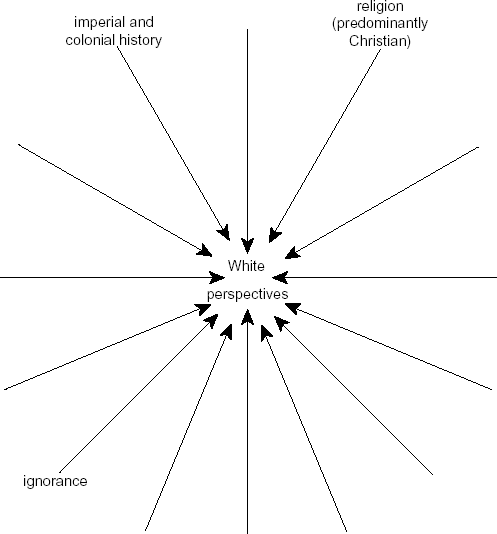
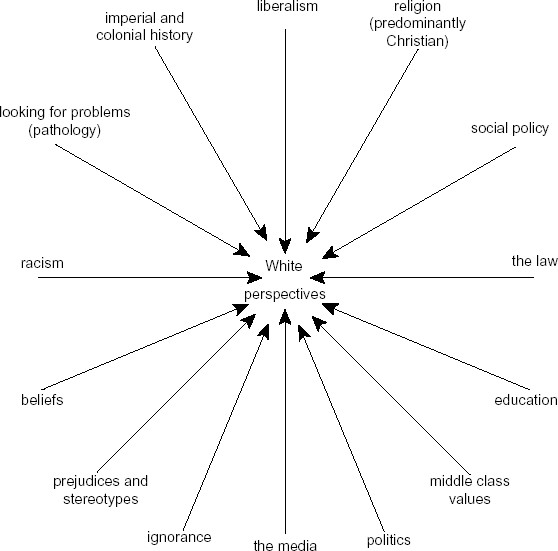
When White people think about a
Black family, what aspects of their history and life experience have
influenced their viewpoint? What produces a White
perspective? Make a list of the views you believe White people may have of
Black families. Allow yourself to think of whatever pops into your head.
If you are a White person, complete Diagram B on the next page from your
own personal point of view. If you are a Black person, write down the
influences to which you think White people have been subjected.
Diagram B: White
perspectives on Black families
Comment
I noted several aspects which
may help to produce a White perspective on Black families. By this I am
not suggesting that every White person sees Black families in the same
way. Nor am I suggesting that all White people have a view of Black
families affected by ignorance and prejudice, or even by liberal thinking.
I am suggesting that White people have a perspective on Black families
which is affected by their shared and particular history and experience as
White people.
BLACK PERSPECTIVES ON THE BLACK FAMILY
Just as the perspectives of
White people are affected by their shared and particular history and
experiences of the culture in which they were brought up, so the
perspectives of Black people are affected by their shared and particular
history and experiences.
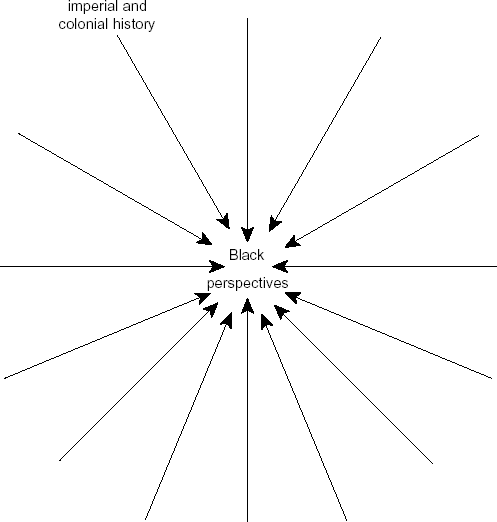
Brainstorm the views you
believe Black people may have of Black families.
If you are a Black person
complete the diagram below from your own personal point of view. If you are
a White person write down what you think are the influences on the way Black
people view the family.
Diagram C: Black
perspectives on Black families
Comment
Did you find that some of the
aspects you considered were linked, but somehow different, perhaps even
the mirror image of what you had put down in the first exercise? Here is
my response:
You may be wondering now whether White social workers can therefore work
successfully with Black families, if their perspective is so different from
how Black people might perceive the family. What way forward is there for
White social workers, if they wish to work successfully with Black families?
TOWARDS ANTI-RACIST WORK
WITH BLACK FAMILIES
Read carefully the
following situation study in the light of the work you have done on
different perspectives on the family.
The B Family
Mr and Mrs B live with
their two daughters, aged seven and ten, in a council flat in Newtown. Mrs
B is expecting another baby in three months. Both Mr and Mrs B came to
Britain as children from Jamaica with their parents. The family suffers
constant harassment from some of their neighbours, with name-calling and
abusive graffiti. Recently rubbish has started to be left outside the door
of their flat.
The head teacher of the
school has referred the situation to the social services department,
because there is concern about recent withdrawn behaviour of the oldest
girl. The school says the family is religious, and they believe the father
over-disciplines the children. They have been unable to get anywhere
talking to the parents, reporting that Mr B is very uncooperative and Mrs
B says little, as though she is depressed.
List the ways in which a
White social worker could work appropriately with this family. If, having
thought it through carefully, you think it is a job for a Black social
worker, say so and give your reasons. Comment
It is important that White
social workers look at their own values and have an understanding of the
historical, social, religious and cultural influences on this family.
Such cultural sensitivity is
a vital part of an anti-racist approach to the family. The social worker
will need to develop an understanding of the girl’s withdrawn behaviour.
It may or may not be related to the father’s approach to discipline. What
is involved in the discipline will be important. It may or may not be a
cultural and religious norm in this family and the particular community to
which they belong.
But there is a danger here
for White social workers. The cultural assumptions may themselves be
racist. Cultural explanations may be based on a comparison with a
supposedly superior White European culture, embedded in centuries of White
domination and oppression of Black cultures. On the other hand, liberal
White people may overvalue the alternative culture. In both cases,
cultural explanations may blind the social worker to what is happening.
The discipline may or may not be overdone. If it is excessive, the child
may need protection.
Cultural sensitivity is
important but it is never enough to enable you to do good work with
families of cultures other than your own. It may be that the girl is
withdrawn because of the harassment the family is suffering. It is equally
important to address the racism involved in this situation. Racism is
certainly an issue in relation to the racial harassment, and perhaps also
in the housing department’s policies and the school’s approach.
Philip Roys explains the
importance of addressing racism as well as being culturally sensitive:
The difficulties faced by the
Black population are the result not only of migration and differences in
culture and language but also of living in a society which is hostile to
Black people, denies them equal life chances and can expose them to
enormous material and psychological pressures. The clients of social
services present with not only linguistic and cultural complexities but
also with the profound effects of racism. In order to offer effective
help, social service institutions must therefore be sensitive not only to
language and culture but also to the process of racism.’
(Philip Roys, 1988, ‘Social
Services’ in Bhat, Carr-Hill and Ohri, Britain’s Black Population,
Gower)
This activity will give
you a chance to reflect on your work in this session and to think about
the ways in which it might have an impact on your work.
Think of a family
situation which is based in a different culture from your own. The family
can be a real one from your experience or an imaginary one. Draw on this
example in your responses to the following tasks.
Briefly describe the
family situation. Then give an example of
the difference between culturally sensitive and anti-racist social work
with this family. SUMMARY
An anti-racist approach to the
family includes both culturally sensitive practice and a challenge to
racism. It involves recognising racism, and doing something about it. It is
about understanding the lack of influence of Black people on the system and
also working to empower Black people. For White social workers, it is not
only accepting that there are Black perspectives on the family, but working
together with Black people to change the system.
The most important thing for
White social workers is to do something about their own racism and the
racism of the organisations in which they work.
SESSION OBJECTIVES
After completing this session
you will be able to:
INTRODUCTION
So far in this unit we have
looked at the family as a disputed notion. We have seen how people looked
back to the past for an ideal of the family. We have examined the
contradictions in society’s view of children. We have also explored
different perspectives on the family, including looking at the issues of
patriarchy, culture and racism. In the remaining units of this module, this
should form your work with children and families.
THE IDEOLOGY OF THE FAMILY
Part of our critical awareness
as social workers is the recognition that there is a ‘dominant ideology’ of
the family. Let’s examine this term.
An ideology is a set of
beliefs about the family, a way of thinking about the family, shared by a
group of people. A dominant ideology is a set
of beliefs, or a way of thinking, which seems to be held by the majority
of people. The dominant ideology of the
family is reinforced through education, the media, the family, work and
other social institutions, and government/social policy. If television advertising
is about selling, you would expect that the advertisements are unlikely to
challenge the current ideology of the family, but rather to mirror it.
Select two TV adverts
which feature the family in some way. They may make some reference to the
family, portray a whole family, or show some aspect of family life.
Briefly describe the
adverts you watched and say how you think they contribute to the current
dominant ideology of the family.
Comment
I saw three advertisements
within two commercial breaks which said something significant about the
family.
The first was an
advertisement for a well-known washing powder, with the mother and child
at home presented as thinking about little else but organising the
washing, and saving on the household budget at the same time.
The second and third
advertisements were, interestingly, selling X and Y brands of gravy
powder. The X advert featured the father cooking the dinner while mother
was out, seemingly a temporary arrangement, because ‘mum’s chops come with
gravy’. Studying this X family over the years would provide an interesting
review of the gradually changing view of what is acceptable in the
organisation of family life. The Y advert, featuring a boy shopping with
his father and meeting up with the new man in his mothers’ life, is
telling another story. It tells of families breaking up, and that fathers
can be carers too.
The dominant ideas about what
is normal family life change over time. You will have to judge for yourself
how far the ideology of the family has fundamentally changed from that of
the nuclear family – a private place, where mother does the caring and the
primary breadwinner is the father.
Today there is more social
acceptance of women working outside the home and fathers sharing in
household tasks. This social acceptance has not necessarily broken down
inequalities of power and responsibility within the family. Your present
experience of family life may be somewhat different from what is presented
in any of these advertisements. Advertisers have to move with the times;
otherwise many potential buyers won’t identify with, or desire, the
situations they portray, and won’t consider buying the product.
The dominant ideology of the
family does not only concern the way most people believe family life is
organised and structured. It also concerns how living in families is the
ideal everybody should achieve. As Diana Gittins explains:
… it manifests just enough
similarity to people’s life situations to make it seem tangible and real
to most. Thus the never-married, the divorced, and the childless can at
least identify part of the ‘ideal family’ with a past childhood or family
distorted in memory, and feel that their own ‘failure’ has been an
individual failing rather than an unrealistic ideal.
(Diana Gittins, 1985, The
Family in Question, Macmillan, p 165)
Politicians refer to the family
repeatedly. Consider how in Britain and the USA party leaders have
unashamedly used election broadcasts to speak up for the family and to
display their credentials as family members. Election leaflets refer to
candidate X as a dedicated family man or as married with children. Anybody
who does not fit this model of propriety has to stay silent about being
single, divorced, lesbian or gay, or they face the possibility of electoral
defeat. Not so many years ago, Peter Tatchell lost a large Labour majority
in Bermondsey to the Liberal, Simon Hughes, mainly because of his outspoken
assertion of being gay.
THE FAMILY IN CRISIS
Many social commentators regard
the family as part of the foundations for a properly organised society. When
things go wrong in a society, a great deal of concern is expressed about a
crisis in the family. This concern often surfaces as a fear for the
breakdown of family life. This fear is then transformed into blaming the
breakdown of the family as the cause of the problems in society. It is a
widely held belief that current social problems are caused by a breakdown of
family life. Consider the following
quotation from Virginia Bottomley, the Health Minister, who was the only
woman member of the government to address the Conservative Party
Conference as reported in The Guardian, 12 October 1991, under the
headline ‘Breakdown of family can lead to life of crime, says Bottomley’.
Time and again, from
so-called joy-riders to horrific instances of child abuse, when the basic
cohesiveness of the family unit breaks down, crime, degeneracy, violence,
and horror break to the surface of our society. When parents give up
caring, children, sometimes literally, run riot. Too many young people
drift easily into a life of crime.
How far do you agree with
the view expressed in the extract? Give reasons to support your answer.
Using this extract as your
starting point, identify the strengths and weaknesses of the belief that
social problems are caused by a breakdown in family life.
You may also draw on your
own knowledge and experience to answer these questions.
Comment
In some ways it is very easy
to agree with this statement. Incidents of joy riding and child abuse have
been increasingly reported in the media. Media coverage highlights this
growing violence. We also know there have been significant changes in the
composition of families in the last 20 years. Here are some examples of
these changes.
Since the beginning of the
1980s, the number of children born outside marriage has more than
doubled, from 77,000 in 1980 to 177,000 in 1987. The ‘extra-marital birth
ration’, i.e. proportion of all live births that are born outside
marriage, has more than doubled from 12% in 1980 to 25% in 1988. Official estimates indicate
that if divorce rates prevailing in the mid-80s were to continue, then
37% of marriages are likely to end in the divorce courts and one in five
children will experience a parental divorce by the age of 16. The General Household
Survey shows that, in 1987, 14% of all families with dependant children
were lone parent families, compared with 8% in 1971 and 6% in 1961. Virginia Bottomley’s
statement may be appealing. But the counter argument is that it
oversimplifies and distorts the issues in the following ways.
A cohesive family unit does
not necessarily mean the nuclear family unit; other family forms can
also be cohesive units. Changes in family
composition do not always mean parents are not caring. Changes in family
composition do not necessarily produce such problems as crime and
violence. In fact, largely through the decreasing proportion of children
and young people in the population, the incidence of juvenile crime has
declined during the last quarter of the twentieth century. Crime and violence have
many causes and cannot be viewed and responded to simplistically. Critics of this argument say
that scapegoating the family for these problems may win a few votes, but it
places the blame where it does not belong, particularly with the mothers. It
diverts the blame from the perpetrators of the crime and violence, from the
economic situation, from the social conditions, and from government itself. Reflect on your work in
this section. Think also about the families you know, either personally or
professionally, before answering these questions.
How far do they reflect
the dominant ideology? What real evidence is there to support the
assertion that the family is in a state of crisis? Why do you think the
family is such a convenient scapegoat for the ills of society? What do you feel you
have learned which will help you in your work with families?
SUMMARY
In this session you have
considered the politics of the family. Most cultures have a dominant view of
how people should live. There can be considerable social pressure to have a
particular living arrangement. This is often an aspect of life which is
taken for granted by the members of that culture. Particular living
arrangements can also become disrupted, and the dominant ideology of what
should be, may increasingly be called into question. Whether or not you
agree with a particular argument about the desirability or otherwise of
changes in present day family life, depends on your own values and politics.
SESSION OBJECTIVES
After completing this session
you will be able to:
explain how social
policies impact on families explain how social
policies can exploit particular family members. INTRODUCTION
Social policy is an important
context for the lives of members of families. All families are affected by
changes in social policies. In the process some families are advantaged and
some are disadvantaged.
SOCIAL POLICIES AND FAMILIES
Social policy often is
concerned with families. Families can be:
the victims of social policy the targets of social policy the instruments of social
policy the beneficiaries of social
policy. Most political parties claim to
be the party of the family, but family life can be undermined by social
policy as much as it can be supported by it. Draw up a list of up to
half a dozen areas of social policy that affect families and family life.
Comment
Many areas of social policy
may affect families and family life. You could have said that all social
policies affect families. But some areas of social policy affect
families and family life much more directly and intimately than others.
These include policies on:
child care health education equal opportunities community care income and wealth
distribution housing. Let’s go on to look at social
policy in more detail.
THE IMPACT OF SOCIAL POLICY
ON FAMILIES
Some social policies directly
affect families while others indirectly affect them, although this
distinction is not always easy to maintain.
One example of the direct
impact of social policy on the family is the recent child maintenance
legislation. This forces absent fathers to pay for the upkeep of their
children, and coerces single mothers into naming the fathers of their
children under the threat of the loss of a proportion of their benefit.
Another example is immigration controls which in many cases keep Black
families apart.
An example of social policy
indirectly affecting the family would be the Education Reform Act. This sets
out the National Curriculum and implies that parents need to find out what
is happening in schools if they are to be involved in their children’s
education.
Public transport policy is
another area of social policy which has indirect consequences for family
members, particularly those who do not have ready access to a private care,
for example, poor families, some women and children.
Housing policy is one example
where it is difficult to draw a distinction between direct and indirect
impact on families. Let’s take just one aspect
of housing policy. The right-to-buy clauses of the Housing Act 1980
required local authorities to sell council houses to their tenants. At the
same time as houses were being sold there were strict controls on the
building of new council houses.
What effects do you think
this policy has had on families?
Comment
The right-to-buy legislation
gave many people what they aspired to, namely the opportunity to purchase
their own home. But not all people wish to be home owners. The legislation
has undermined the justification for preferring renting as a form of
tenure, and at the same time diminished the choices available to families
and individuals. The stock of local authority housing has diminished
dramatically because of the act, at the same time as cuts in spending on
public housing. According to the Chancellor of the Exchequer, public
expenditure on housing was cut by 79% between 1979 and 1988 (as reported
in The Guardian, 2 November 1988). The majority of homes that have
been sold are family homes, often on more expensive suburban estates. This
had massive effects on:
the availability of housing
for families trapped in council accommodation which was not appropriate
to their needs homeless families the choices of council
tenants the unity of communities. Some parts of housing estates
have stayed in the public rented sector while others have become private.
It could be argued that when the children from these estates grow up and
want to form their own families, it may be more difficult for them to live
close to their parent(s) than it was 50 years ago. Thus they may lose the
mutual support so important to many families.
In summary, the right to buy
has been good news for some people, but very bad news for many more
people, particularly when linked with the constraints on local authority
house-building.
FAMILIES AS INSTRUMENTS OF
SOCIAL POLICY
Not only can families be the
victims of social policy, they can also be its instruments. One of the main
political debates in Britain in the last quarter of the twentieth century,
has been about the role of the welfare state. This debate has tended to
focus on whether the welfare state is seen as supporting or undermining
families and family life. The relationship between the state and the family
also has been debated. It is worth asking whether the state is taking over
the role of the family. Think of somebody you know
who needs some sort of physical care. Spend five minutes making notes on
who provides this care and where it is provided.
Comment
Obviously your answers are
specific to your own experience. However, these questions are of
particular interest to social workers. Does the state provide care or do
family members provide it? Is the care provided in people’s homes, or away
from their homes, in state services, provided by health, education and
social services?
The majority of care is
provided by family members, mostly women, within people’s own homes. The
state has a comparatively small role in providing much of this care, which
is referred to as community care and is very much associated with child
care. Instead, family members are encouraged to care for people in their own
homes, and also take advantage of the growth of the voluntary and private
sectors. Often this means that women care for their relatives at great
emotional cost and, if they need to work, financial loss to themselves.
SUMMARY
This session on families and
social policy is the last session of this unit. The session has introduced
you to the complex relationship between social policy and the lives of
family members. It has also dealt with the significant impact of social
policies on family life.
UNIT SUMMARY
In this unit you have looked at
various aspects of the family. You began by exploring ideas and ideals of
the family. You then saw how the representation of the golden age of
Victorian family values is not altogether realistic. Looking at inequality,
you have examined some of the effects of racism and sexism in families. You
have considered the political ideology surrounding families and how this
will affect your work as a social worker. Finally you have seen some of the
ways in which social policy affects families.
FURTHER STUDY
Here are some suggestions for
reading which will help you follow up the main areas covered in this unit.
Especially Session 1
Gittins, D, 1985,The Family
in Question, Macmillan, London.
Humphries S, Mack J and Perks
R, 1988, A Century of Childhood, Sidgewick and Jackson in conjunction
with Channel Four.
Rapport R N, Fogarty M P and
Rapoport P, 1982, Families in Britain, Routledge and Kegan Paul,
London.
Walvin, James, 1982, A
Child’s World, Penguin.
Black perspectives and
anti-racism
Ahmad, B, 1990, Black
Perspectives in Social Work, Venture Press.
Ahmed S, Cheetham J & Small J,
1986, Social Work with Black Children and their Families, Batsford.
Bhat A, Carr-Hill R and Ohri S,
1988, Britain’s Black Population, Gower.
Dominelli L, 1988,
Anti-Racist Social Work, BASW/Macmillan.
Humphries S, Mack J and Perks
R, 1988, A Century of Childhood, Sidgewick and Jackson in conjunction
with Channel Four.
Morgan D H J, 1975, Social
Theory and the Family, Routledge and Kegan Paul.
Walvin, James, 1982, A
Child’s World, Penguin.
Especially Session 3 and 4
Townsend, Peter, 1979,
Poverty in the United Kingdom, Penguin.
Webb, Beatrice, 1971, My
Apprenticeship, Penguin.
Especially Session 5
Dominelli, Lena, 1986,
‘Father-daughter incest: patriarchy’s shameful secret’, Critical Social
Policy, Issue 16.
Especially Session 6
Ahmad, Bandana, 1990, Black
Perspectives in Social Work, Venture Press.
Ahmed, Shama, ‘Cultural Racism
in work with Asian Women and Girls’ in Ahmad, Anti-Racist Practice, 1991,
CCETSW.
Cheetham and Small, 1986,
Social Work with Black Children and Families, Batsford.
Kiernan K and Wicks M, 1990,
Family Change and Future Policy, Joseph Rowntree Memorial Trust in
Association with the Family Policy Studies Centre.
van Every J, ‘Who is “the
family”? The Assumptions of British Social Policy’, Critical Social
Policy, Issue 33, Winter 1991/92.
Especially Session 7 and 8
Gittins, Diana, 1985, The
Family in Questions, Macmillan, London.
How much has the family changed? New Society 27 October 1983
pp 143-146
...We do not know how many
marriages were broken by desertion or separation in the past, though
contemporary comment suggests that the numbers were not small. What we do
know is that, of couples who married at the average age in the 1860s, around
one in three had their marriage broken by death within 20 years. Their
figure is remarkably close to the death-plus-divorce expectations of couples
marrying today. The chances that a child would experience a broken home were
higher right up to the end of the 19th century than they were during the
1970s.
...Victorian sexual morality
was rather different from the image which seems to be held by some of the
moralists in our own society. Prostitution was widespread, some of it highly
organised (including a flourishing trade in children), much of it a source
of supplementary income for ill-paid or out-of-work milliners, dressmakers
and domestic servants.
...The ‘double standard’ of
Victorian sexual morality was notorious, and it was reinforced by the sexual
frustrations imposed upon so many marriage beds by the ignorance and prudery
in which most middle class girls were brought up.
...Among the mass of the
population, however, such inhibitions were less present. Illegitimacy was by
no means rare. In the early nineteenth century, more than half of all first
births were conceived out of wedlock, a figure which fell only slowly over
the early part of the of the century. In the 1850s, on average, more than 6
per cent of all births in England, and more than 8 per cent in Scotland,
were illegitimate (compare this will 8.4 per cent for England and Wales in
1971, and 11.8 per cent in 1980).
...What about the control
exercised by the family over its members, and care and affection between
generations? ...Half of all adolescents left by the age of 16 to go into
service, lodgings or apprenticeships, so the problem of control was clearly
rather a different one to our own. However, particularly in the
manufacturing towns, it was a major problem of contemporary concern – and
for remarkably modern-looking reasons.
In Lancashire one writer noted
that, by the age of 14, ‘many of them begin to have strong desires for finer
clothing, or other things, and they frequently stipulate with their parents
for some portion of their wages’. Another noted that ‘where they receive as
much money as will more than pay for their living, they contract with their
parents for board and lodging, and put the rest in their pockets .... and
{become} thoughtless and independent’.
Many Victorian parents clearly
loved their children and did everything they could to ease the suffering
that was often their lot in life. But you get a strong impression from
contemporary accounts that wife-beating, family neglect and brutality
towards children were more frequent in Victorian Britain than they are
today. One factor must have been the enormous quantities of alcohol drunk,
especially by men (peaking in the 1870s at an average of something
like eleven pints of beer and one third of a pint of spirits per adult male
per week). Among the middle classes there is strong autobiographical
evidence to suggest that many felt a remoteness and fear of their fathers
which inhibited any real affection for the whole of their lives.
...Despite the popular image of
Victorian children listening to stories at their grandmother’s knee,
three-generation households were surprisingly rare in the past. In 1851, 20
per cent of Scots aged 65 and over lived apart from any relative (the same
percentage as in Britain in 1962); only 16 per cent lived with a married
child, again the same as in Britain in 1962. ...We should not conclude that
our own age is the only one in which relationships between generations have
posed problems.
Our myth of a stable,
solicitous and moral past comes in part from a perennial tendency to
romanticise family life in earlier generations (a process which we can trace
right back to medieval times). It also derives from the ideals of a segment
of the respectable upper middle classes. They often did not manage to keep
to these ideals themselves but it did not stop them seeking to impose them
on the working classes.
...Victorian family life was
very different from out own, but not in some of the more superficially
obvious way often seized upon by today’s moralists. It was a product of its
own economic, social and demographic situation. It has passed for ever and
we should not regret its passing. Greater economic insecurity may bring back
some features of Victorian (or even interwar) family life. But a return to a
more unpredictable life-cycle would not have positive economic or social
consequences. |
||||||||||||||||||||||||||||||||||||||||||||||||||||||||||||||||||||||||||||||||||||||||||||||||||||||||||||||||||||||||||||||||||||||||||||
 Activity 1