|
SOCIAL WORK WITH CHILDREN AND
FAMILIES
Unit 11: Children and Families and Special Needs
Unit Objectives
After completing this unit, you
will be able to:
- identify
the use and value of appropriate language in relation to children with
special needs
- describe
the legal framework for children with special needs in England and Wales
- evaluate
the relationship between needs and services for children with special
needs and their families
- inform your
social work practice with an understanding of anti-oppressive issues.
Session One
What are Special Needs?
Session Objectives
After completing this session
you will be able to:
- list the
terms used to identify children with special needs
- use the
appropriate terms for children with special needs
- identify
the barriers to integration and participation experienced by children with
physical disabilities
- define the
social characteristics of childhood.
Introduction
Defining special needs
The different words used to describe people with special or additional
needs can often serve to confuse rather than clarify the subject. Terms such
as ‘disability’, ‘handicap’, ‘difficulty’ and ‘impairment’ appear
interchangeable. Specific terms used in the past, such as ‘spastic’
‘cripple,’ ‘feeble-minded’ and ‘cretin’ are now used as insults but remain
part of our language. This change in language reflects society’s view of
people subject to such labels. The use of terms also indicates the way
services have been organised, either to protect able from disabled people,
or to protect disabled from able people.
The language you use as a
citizen or social work professional to describe a service user indicates a
value base. ‘Value base’ denotes a set of beliefs that underpins a
philosophy of care and the services provided. For example, this might
include a belief that all children have the same basic rights regardless of
race, religion, ability or attainment and should not be segregated from
mainstream services because they appear to be different.
 Activity 1
 |
This activity should take
you about 20 minutes.
Reflect on the experiences
of your own childhood, in terms of your family, neighbourhood and
schooling.
-
List the names or labels
given to children or adults who were seen as different by virtue of
having special needs.
-
Now put the list in two
columns in the space below, according to whether you consider the terms
positive or negative.
Positive terms
Negative terms
Comment
We would be surprised if you
were able to identify any positive terms, labels or names. While some may
be less abusive or harsh than others, it is unlikely that any labels are
ones you would like attributed to yourself. Many terms that you might have
included are obsolete medical terms – such as cretin, imbecile, idiot,
lunatic – that remain as part of everyday language and continue to
reinforce a negative view of differences. Such terms appear today in the
case notes of adults who as children were using services as recently as
the 1960s.
Terminology: impairment,
disability and handicap
The 1960s may have been the end of the ‘bad old days’, but how much have
things changed?
You now need to consider how
language as currently used indicates people’s value base in relation to
those with special or additional needs. The next activity asks you to use a
small number of contacts, to gauge public understanding of the terms used.
|
Activity 2
|
Allow about one hour in
total – though you may need to plan it now and carry it out later.
Briefly interview four
people to whom you have easy access (friends, neighbours, relatives) and
who are not employed or engaged in social work, education or health
services.
Ask your interviewees what
they understand by the following terms.
-
impairment
-
disability
-
handicap.
Introduce each word
separately and record the responses. Note any common key words that appear
in the responses.
Use the space below to
record your responses.
Interviewee 1
Interviewee 2
Interviewee 3
Interviewee 4
Comment
Although the terms
impairment, handicap and disability are commonly used in the same context,
their respective definitions are quite distinct. It is likely that you
found one or more of the terms used to define another term. Equally, you
may have encountered the view that two or three of the terms meant the
same thing.
For the purposes of this
unit, we prefer the following definitions, taken from the World Health
Organisation in 1982. We recognise that these official definitions may
seem complex. You might want to pause for a few minutes to think them
through.
Impairment means a
permanent or transitory psychological, physiological or anatomical loss,
or abnormality of structure or function.
Disability means any
restriction or prevention of the performance of an activity, resulting
from an impairment, in the manner or within the range considered normal
for a human being.
Handicap means a
disability that constitutes a disadvantage for a given individual in that
it limits or prevents the fulfilment of a role that is normal depending on
age, sex, social and cultural factors, for that individual.
Here is an illustration of
how these terms might be used. We might refer to a child’s impairment
as spina bifida, resulting in a specific disability (unable
to walk independently), leading to a handicap of not being able to
use public transport or gain access to the local leisure centre.
Throughout the literature,
you will encounter other definitions which may add to, or challenge, those
given above. The major challenge may come from disabled people themselves,
some of whom see definitions as tools used by able-bodied or non-disabled
people to categorise the nature of disability. Michael Oliver, in The
Politics of Disablement, refers to the questions used in a 1986 survey
of disabled adults. In the survey the key words were ‘deformity’,
‘problem’, ‘difficult’ and ‘wrong’ – all used in the context of the
persons interviewed. Instead of asking: ‘What is wrong with you?’ Oliver
suggests the question should be: ‘What is wrong with society?’
In 1980, The Union of the
Physically Impaired Against Segregation defined disability as:
The disadvantage or
restriction of activity caused by a contemporary social organisation which
takes little or no account of people who have physical impairments and
thus excludes them from participation in the mainstream of social
activities.
Our use of the term ‘special
needs’
This unit uses the term special needs because it embraces the broadest
definition of need, following the education Acts of 1981 and 1993. Ideally,
we would prefer the term ‘additional’ or ‘specific’ needs. A child with an
asthmatic condition has the same needs as one with epilepsy. These would
include self-medication skills, perhaps dietary needs, and the need for
positive responses from adults and other people in authority. We recognise
that the term ‘special needs’ can be seen as patronising and emotive, but
since it is a term with legal and professional currency, we have chosen to
use it in this unit.
Barriers to Integration
The following activity is
intended to show how the values and attitudes of others frame the world for
the child with special needs.
|
Activity 3 |
This activity should take
you about 20 minutes.
Do you think it would be
possible for a wheelchair user to have attended the same school as
yourself, and to have had similar opportunities to attend clubs, leisure
facilities and so on? You should respond to this question by:
These factors may be
positive – the school was all on the ground floor – or negative – the
school was only accessible via a flight of steps.
If you are a wheelchair
user, indicate the extent to which you consider your education and leisure
opportunities to have been segregated from the mainstream.
Comment
If you are a wheelchair user,
your examples of restricted opportunities will have been all too easy to
identify.
The extent to which children
who use wheelchairs are accommodated by schools and other services varies
enormously. Much will depend on where and when you went to school. Today,
even the most positive scenario will involve a wheelchair user having
access to only parts of buildings. For example, access to the swimming
pool in a sports centre may be possible; access to the viewing gallery or
cafe facilities may not be possible.
Social Construction of Disability
and Childhood
The process we considered in
the last activity is termed ‘social construction’. If we take a view of
disability as essentially a restriction imposed upon a person by others, we
form a social construction of disability – something defined by society
rather than by medicine or science. As societies vary, so does the way in
which they define groups of people as valued or problematic.
This unit is concerned with
children who have special needs. You have already begun to consider the
social construction of disability; let’s now consider the social
construction of childhood. This is necessary if we are to see children with
special needs as children first and foremost.
|
Activity 4 |
This activity should take
you about 30 minutes. It asks you to consider how ‘childhood’ is defined
in the United Kingdom.
-
Write down your own
definition of childhood in terms of your own experiences.
-
Select and write down an
official definition of childhood using sociology text books or legal
documents such as the Children Act 1989.
-
Compare and contrast the
two definitions. When does childhood end and adulthood begin? What does
being ‘a child’ mean? Is childhood an age? A status? A stage of
development?
-
Consider to what extent
the definitions apply wholly or in part to children with special needs.
Comment
According to the Children Act
1989, a child is considered to be someone under the age of 18 years.
Official definitions will often confer adult status in terms of legal
rights – the right to vote, the right to marry, to drive a car, to leave
school. Thus adulthood, and by definition the end of childhood, occurs
around ages 16 to 18.
Society tends to see
adulthood in terms of starting work and leaving home – transitions that
may occur for different people at different times. Thus adulthood depends
upon who you are (How old are you?) and what you do (Where do you live?
What work do you do?).
For children and young people
with special needs, the social construction of adulthood and the end of
childhood may be different. If society views adulthood as synonymous with
financial, emotional and practical independence, then people with special
needs may experience ‘infantilisation’ – being seen as children whose
development is delayed. The continued reliance on others in tasks of daily
living, the restriction of opportunity imposed by various barriers and the
lack of appropriate support services, can contribute to a seemingly
extended childhood.
|
Activity 5 |
This activity should take
you about 30 minutes.
So far in this session, we
have referred to one form of special need – a child who is a wheelchair
user, and one form of barrier – a physical one. Using the situation
studies in Appendix 1, please proceed as follows.
-
List any
other specific impairment disability, characteristic or condition that
you think comes under the term ‘special need’.
-
Using
your list, identify two or three ways in which children with special
needs may be excluded or segregated from activities enjoyed by other
children.
Comment
In constructing your list,
you may have found the task of deciding what to include and exclude very
difficult. The Children Act 1989 defines any child who is disabled as a
child in need (Section 17 of the Children Act 1989). The definition of
disability mirrors and repeats the National Assistance Act of 1948 stating
that:
… a child is disabled if he
is blind, deaf or dumb or suffers from mental disorder of any kind or is
substantially or permanently handicapped by illness, injury or congenital
deformity or such other disability as may be prescribed.
Your list will probably have
included a reference to some children having either a mental handicap,
learning difficulty or a learning disability. Even the choice of terms,
once again, can be confusing. The Education Act 1981 defines a learning
difficulty as a boy or girl who has a:
… significantly greater
difficulty in learning than the majority of children of his/her age, or
has a disability which either prevents of hinders him from making use of
education facilities of a kind generally provided in schools, within the
area of the local authority concerned, for a child of his/her age.
You may have noted that the
ways in which some children with special needs are excluded or segregated
are more complex than simple questions of access to the physical
environment. Opportunities for integration implicitly reflect social
attitudes to acceptance. Put simply, are children with special needs
wanted and welcomed within certain social and educational settings? You
may have identified resources as contributing to segregation: for example,
lack of support staff may lead to the exclusion of children with a sensory
impairment from a particular school.
|
Activity 6 |
This activity should take
you about 15 minutes
Following on from the
above comment consider how your life would have differed if you had an
impairment (or a different impairment from your own).
-
Where
would you have gone to school?
-
Where
would you have lived?
-
How would
your life chances have been different?
Comment
When we were small, children
with a specific impairment were often placed in special schools, hidden
away from mainstream society. If life chances for such children are to be
different today, and children with special needs are to be seen as
children first, we have to begin by identifying needs.
Summary
In this session, you should
have had the opportunity to reflect on your own values about children with
special needs. If you are able-bodied, you may well have become aware for
the first time of the absence from your life of children with special needs
– you may have completed your educational experience segregated from
children with various impairments. This will apply particularly if you are
an older learner. You might have reflected on the ‘invisibility’ of children
with particular needs and on how your particular life experience and
opportunities would have been different had you been a child with an
impairment.
In Session Two you will
consider how needs can be identified by focusing on the child, not the
impairment or the condition.
Session Two
Identifying Needs
Session Objectives
After completing this session
you will be able to:
- identify
needs of children with special needs and their families
- consider
children’s needs in relation to age, gender, ethnicity and ability.
Introduction
Identifying needs is a complex
process. Traditionally, services for all welfare users have been led by
fitting people into available or existing facilities, rather than by
identifying needs as a starting point. For the purposes of this session, we
will ask you to put aside your knowledge of services and resources and
concentrate on the needs of children with special needs, and the needs of
their families and other carers. Needs are both essential (food, shelter,
warmth and health) and relative (finance, independence, dignity, rights, and
leisure), and therefore any identification of needs must take account of
both elements.
A helpful definition of need
appears in the Care Management and Assessment Guide produced by the
Social Services Inspect orate and Scottish Office Social Work Services
Group. They use the word ‘need’ to indicate:
… the requirements of
individuals to enable them to achieve maintain or restore an acceptable
level of social independence or quality of life, as defined by the
particular care agency or authority.
|
Activity 7 |
This activity should take
you about 15 minutes.
Read the following brief
situation study, and then try to answer the questions below. All the
people in the study have basic needs, and additional, specific needs.
Mr and Mrs Benjamin live
with their three children in a three-bedroomed house. The youngest of
their two daughters, Jasmin, is nine years old and has Downs Syndrome.
Apart from a few words she is unable to speak but seems to understand most
of what is said to her. She is overweight and loves her food. Her mobility
is limited, walking very slowly and her parents describe her as ‘lazy’,
although she is seen as mischievous and needing constant attention. She
attends a local special school. Since she was born her parents have not
gone out or socialised very much. They are described as being devoted
parents to Jasmin but find her demanding and a strain on the family.
Using the definition of
needs, given prior to this activity what do you think might be the needs
of:
You might find it useful
to begin identifying needs from the position of what would be the needs of
an ordinary nine-year-old girl and her family. This perspective is
endorsed by the Children Act Guidance and Regulations which state that
children with special needs are ‘children first’.
Comment
Jasmin’s special needs may be
better seen as additional needs. She has the same needs as all other girls
of her age but also specific extras. There is a tendency to focus on the
‘special’ needs and ignore the basic, universal needs. Similarly, Mr and
Mrs Benjamin and Jasmin’s siblings have the same needs, hopes and desires
as other parents, and other brothers and sisters. They all have basic
needs and additional specific needs.
The Needs of Children
In The Needs of Children,
the late Dr. Mia Kellmer-Pringle refers to a classification of four needs:
The Care Management and
Assessment Guide refers to the categories of:
The Needs of Other Family Members
It is important to address
separately the needs of parents and carers, and siblings. The additional
needs of parents include:
-
confidence to
ask for assistance
-
awareness of
what services are available
-
to feel
listened to
-
to enter a
partnership with service providers.
Similarly, children in families
where a child has additional needs have specific needs of their own:
|
Activity 8 |
This activity should take
you about five minutes.
In terms of your
identification of needs for Jasmin and her family, what categories of need
should be the concern of the social worker?
Comment
In answering this question,
you may have begun to think about needs for services – it is inevitable
that we think about the social worker’s role in terms of the services
provided by the social services department. However, we will address the
question of services in Session 3. You will probably have recognised that
most practical needs from the Care Management and Assessment Guide
listed above, such as accommodation, education, employment, finance and
transport, are the responsibility of other agencies. So which are the
particular concern of the social worker? Our view is: all of them, in
terms of enabling Jasmin and her family to identify their own needs.
For example, you may have
suggested in your answer to Activity 8 that Mr and Mrs Benjamin need a
short-term residential facility for Jasmin in a local children’s home.
However, in terms of needs, it may be more accurate to say Mr and Mrs
Benjamin need to discuss the desirability of some form of respite care.
This may be met in many different ways – the common thread being that the
service that is eventually provided should be needs-led rather than
service-led. This means that the service has to fit the needs of the
individual, rather than the individual having to fit existing services.
Since orphans – children
literally without parents – are virtually absent in our society, all
children, whether they have special or additional needs or otherwise,
belong to a family. We therefore need to move onto considering the family
relationships surrounding children with special needs.
Families and Special Needs
The family is a complex
institution. Just as children with special needs do not constitute a
homogeneous group, then neither do their families. The fact that one or more
members of a family have special needs does not necessarily indicate the
need for a large amount of support or services.
-
Just as needs
and services are affected by a value base (as we noted in Session 1) then
so too are families. This point is considered, among others, by Seligman
and Darling in Ordinary Families, Special Children, Guildford
Press, New York, 1989. They refer to an ideological style in each
family, based upon a family’s beliefs, values and coping behaviour. Such
an ideological style within any family will revolve around such notions
as:
– the relationship between
children and adults
– the task of parenting and
the roles of men and women
– the expectations of
children in terms of behaviour and achievement
– the extent to which
families expect to be independent and self-reliant
– the roles of other family
members
– the ways families
experience services such as education and health.
|
Activity 9 |
This activity should take
you a total of about 45 minutes in three sections of 15 minutes each.
-
Using the categories
listed above, try to identity the ideological style of your own family
of origin.
-
Putting yourself in the
role of either Mr or Mrs Benjamin, try to imagine what ideological style
would operate in your family.
-
Continuing in the role
of Mr or Mrs Benjamin, and based on your ideological style, what would
you expect from a social worker?
Comment
You may also have put near
the top of your list that although you, as a parent, know the needs of
your child best, you would expect the social worker to have a working
knowledge of:
-
your
daughter’s condition
-
her medical
needs
-
services
(such as education)
-
your rights
and entitlements in terms of welfare benefits.
In other words, you don’t
expect the social worker to know best, but you do expect them to know
quite a lot. The extent of a social worker’s involvement with any family
will depend upon the family’s ideological style. The impact of a child
with special needs will vary according to the way the family members react
to any disability and cope with the particular pressures that result.
In her research with families
caring for a child with disabilities, Glendenning in A Single Door,
Allen and Unwin, 1986, listed the types of interventions by social workers
as including:
-
the child’s
day-to-day care and development
-
parents’
feelings
-
contacts
with schools
-
practical aids and adaptations
-
advice and
counselling with marital difficulties
-
addressing
problems with siblings
-
concerns
with finance and welfare benefits
-
concerns
with housing problems
-
the need for
holidays and respite care
-
issues of
employment and training.
Assessing Needs
The above list indicates the
knowledge base for a social worker working with children with special needs.
We will consider the issues of social work training and the debate between
specialist and generic services in the final session.
|
Activity 10 |
This activity should take
you about 15 minutes
Consider the following
situation and then address the questions that follow.
Mr and Mrs Patel have
recently moved into the area. They have a daughter, Sarbjit, who is 12
years old and deaf and blind. They have moved into accommodation over a
shop owned by Mr Patel’s brother who has written to the social services to
ask for help, requesting a visit from a social worker. Apart from the
address, no further information was given.
On receiving this letter,
what further information would you want? Complete this activity by drawing
up a list of headings that could form the basis of an assessment of need.
For example:
Comment
On the basis of your previous
work on ideological styles in families, you might have begun your
assessment by considering what asking for a service means for Mr and Mrs
Patel and for Mrs Patel’s brother. You would need to address issues of
race, religion and culture in terms of how Mr and Mrs Patel and the family
make sense of their daughter’s condition and needs.
The above points link to the
notion of self-perceived needs – the principle that service users are best
able to say what they need and want; the view of the brother who wrote the
letter; the views of Mr and Mrs Patel; the views of Sarbjit herself.
When receiving different
pieces of information from any of the family members it is important that
you acknowledge your assumptions concerning the impact of special needs on
different circumstances. Social workers are likely to impose their own
ideological styles of family life and parenting on any situation that they
encounter. For example, White social workers may be prone to carrying the
assumptions that Asian families always look after their own people into
their first response to the letter from Mr Patel’s brother. As a result
they may be surprised that this family has asked for help in the first
place. Similar assumptions relate to issues of gender – that women are
always the primary carers of children in any family.
To recognise the assumptions
and stereotypes carried by all practitioners, we wish you to move onto
gender considerations.
Gender and ethnic considerations
|
Activity 11 |
This activity should take
you about 15 minutes.
We believe that your
gender identity – how you experience being a girl or a boy, beyond
biological difference – stems from family experiences, cultural norms and
wider social values.
In the previous situation
study, Sarbjit is a 12-year-old girl. Remember when you were a 12-year-
old girl or boy.
-
What expectations of you
as a girl or boy were expressed by your parents, carers and other family
members?
-
What were the
expectations at school concerning your identity as a boy or girl?
-
What did you expect of
yourself?
-
Do you think these
expectations would have been the same if you were a child with a
specific disability?
-
If you are a person with
a disability, how might this set of expectations have been different had
you been an able-bodied boy or girl?
-
How might these
expectations differ for a boy or girl of a different race from your own
with a specific disability?
Comment
The ways in which gender is
expressed and confirmed varies between cultures. Within the United
Kingdom, gender image is often associated with fashions of dress, hair
styles, jewellery, facial hair, tattoos, and make-up. You may have
identified specific activities such as sports, leisure pursuits, and
pastimes. You may also have referred to different expectations within the
family concerning roles and tasks or different expectations from teachers
about achievements and behaviour in schools. You may have recognised that
Black children with a specific disability experience double disadvantage
or double jeopardy in that within a White, able-bodied society, children
or young people who are different by virtue of race and ability are
discriminated against twice.
Much of our thinking about
gender identity in teenage years relates to the way children make the
transition from childhood to adulthood. This significant part of the life
course will also vary between different cultures. In some cultures, the
transition from childhood to adulthood, for boys and girls, is marked by
formal rituals, ceremonies or ‘rites of passage’. In other cultures, such
transitions are more informal and haphazard. This is an important area for
children with special needs, which you will return to in Session 5.
|
Review activity |
This activity should take
you about 20 minutes.
Considering sexuality
Considerations of
sexuality in relation to young people with special or additional needs
have been ignored until recently. This activity asks you to compare
opportunities and issues of sexual identity for two young women, similar
in all respects other than their physical ability.
Jane is a White, 17 years
old and a wheelchair-user in a residential school. Her cousin Sarah is of
the same age, lives with her parents, is able-bodied and attends a
sixth-form college.
Bearing in mind the
expectations of a White society concerning young women and their
sexuality, please answer the following questions.
-
What could Jane and
Sarah expect to be able to do?
-
What could Jane and
Sarah expect not to be able to do?
-
What could Jane and
Sarah expect of their parents or carers in terms of advice, guidance or
services?
Comment
You may have found it
difficult to answer the questions. For example, it is not always easy to
recognise young people with disabilities as sexual beings. The powerful
cultural and media images we all absorb link sexuality with bodies that
are flawless and perfect.
People express their
sexuality in terms of fashion, dress, image and style as well as behaviour
with others. In exploring these types of expression, young people require
the opportunity to make choices. You may also have thought about the
opportunities for both Jane and Sarah to have access to services such as
family planning clinics and other advisory centres.
Summary
Many of the themes in this
session would be the same for the identification of needs in relation to any
other group of service users. That is precisely the point. The traditional
medical model of needs and services for children with special needs has
focused, often exclusively, on the impairment itself. Here we have tried to
see needs in terms of the child or young person’s context – her family,
carers and environment; her racial and gender identify; her age and
sexuality; her life opportunities and the structural barriers to the
realisation of potential.
If you are an able-bodied
person, the activities may have enabled you to think about some of these
issues afresh. If you are a person with a disability, we may not have
introduced anything new, but you may have been able to put your personal
experiences into a different context, or to have thought about the needs of
children and young people with disabilities different to your own.
Session
Three
From the Identification of Need to the Provision of Services
Session Objectives
After completing this session
you will be able to:
- identify
the agencies responsible for providing services to children with special
needs and to their families
- describe
the relationship between social services departments, health services,
local education authorities, the voluntary sector and the private sector
- list the
services available in your area to children with special needs and their
families.
Introduction
In Session One we referred to
the philosophy of care, and how this was reflected in the provision of
services. Services have evolved over time, and at the time of writing this
unit, legal changes are being implemented in the areas of health care,
education and social services. We will look a the legal framework in
Sessions Four and Five.
You will begin this session by
attempting to map out the range of services provided by different agencies
for children with special needs and their families. We don’t expect you to
be familiar with all sectors and agencies that have a part to play, but the
first activity will serve to help you check out the knowledge you already
have in this field.
|
Activity 12 |
This activity should take
you about ten minutes.
Service providers can be
grouped into different sectors and agencies. Agencies are organisations.
Some are charities, some are part of national and local government.
Agencies operate within particular sectors. For example, social services
are an agency within the statutory sector of the local authority.
In ten minutes, list as
many as you can of the sectors and the agencies within those sectors that
might provide services for children with special needs and their families.
Comment
As we indicated in Session
One, your answers will depend on where in the United Kingdom you live.
Although the sectors will be the same, the balance and levels of services
will vary. The different sectors are as follows:
-
local authorities (London
boroughs, metropolitan authorities, county councils, and district
councils)
-
area health authorities
-
voluntary agencies and
charities (the voluntary sector)
-
the private sector
-
non-profit based trusts and
consortia.
It is likely that you
identified the first four sectors. The last type has only gained public
attention in the past few years. The balance of services between the
different sectors has changed rapidly in recent years.
The National Health Service
and Community Care Act 1990 signified a major shift for health authorities
and social services departments, which are increasingly seen as enablers
rather than providers of services. This has resulted in a growth of
service provision in sectors 3, 4 and 5 – the private, voluntary and
trust-based sectors.
In your list, you may have
noted voluntary organisations such as MENCAP, The Spastics Society, The
Association for Spina Bifida and Hydrocephalus, RADAR, Dr Barnardos the
National Children’s Home, among others.
You may have mentioned some
or perhaps all of these:
Heath authorities
acute medical services
paediatricians
family health services (including GPs and health visitors)
speech therapy
occupational therapy
long-term and short-term residential care
child and family psychological services
Social services
social workers
home care services
occupational therapy
family centres
funding for day-care and child minding
Local education authorities
schools (mainstream and special)
nursery schools
educational psychology
educational welfare services
residential special schools
careers advisory services
District housing authorities
housing adaptations and conversions
provision of local authority housing
welfare rights advice and benefits
Voluntary sector
parent support groups
social clubs
advocacy and campaign groups
toy libraries
pre-school play groups
play schemes
holidays and leisure activities
welfare visiting services
portage schemes
schools
long-term and short-term residential care
respite care schemes
Private sector
long-term and short-term residential care
schools
nursery schools and day-care
Who is really providing the bulk
of care?
Even in areas where the list of
services appears comprehensive you should recognise that the largest
providers of care remain informal carers. There are an estimated six million
carers in the UK for all client groups, and they are central to the concept
of care in the community. Most of these carers are looking after someone
within their immediate family.
|
Activity 13 |
This activity should take
you about three hours in total, perhaps spread over two days.
From the four brief
situation studies in Appendix 1, choose one family with which you find it
easiest to identify (this may be in terms of your age, race or gender).
Your task is to research
the services that are available in your area for the child and his/her
family. In carrying out this activity, you may have clear ideas of what
services should be available, but find they are absent. If this is the
case, you are identifying gaps in service provision. You may also
encounter difficulty in obtaining information. It may be difficult to read
or understand or it may be produced in only one language (English). Such
difficulties will indicate to you some of the practical problems facing
any family that wishes to seek advice, support of services. You should
therefore note down any difficulties encountered in carrying out the task.
You should be able to
obtain written material and leaflets about services from such places as
social services offices, health centres, the education department,
Citizens Advice Bureaux, public libraries and volunteer bureaux.
You should come across the
Community Care Plan, a document that all local authorities and health
authorises are required to produce jointly under the National Health
Service and Community Care Act 1990. This is available from public
libraries and upon request from social services or health authorities.
When you have completed this activity (which you will find more or less
difficult, depending on your location and access to information) move on to
Activity 14.
|
Activity 14 |
This activity should take
you about 20 minutes.
Using your chosen
situation study, you should now have a list of services available in your
area. The issue that now concerns us is how these services are
coordinated. In Appendix 3 you will find an ECOMAP, taken from the
Guide for Social Workers Undertaking a Comprehensive Assessment,
Department of Health, HMSO, 1988.
Place the child of your
situation study in the middle of the ECOMAP and add the services that may
be available to the child and his/her family. You should then draw lines
between the circles indicating the relationships between such services.
Comment
Your map will probably appear
complex, even messy. If so, it will emphasise the need for effective
coordination of services, to avoid duplication, inconsistency and
confusion. You may have found in your area that there are
multi-disciplinary services, embracing more that one agency. These may be
called community learning disability teams or community mental handicap
teams. Other joint-agency links will be at the levels of service planning
and funding.
Many service users and their
families have found it useful to relate to one person responsible for the
coordination of services. Such a person is often called a keyworker. In
the light of funding arrangements under the community care system, the
keyworker will often be a field-based social worker, working in a
community learning disability team. His or her role is to:
-
identify
need
-
assess
appropriate services
-
purchase
optimum services from the statutory, voluntary or private sectors
-
monitor the
effectiveness of services.
Summary
One of the principles of the
community care system is the separation of the identification of need from
the provision of services. In the health services the former is done by the
purchaser, who then buys the appropriate services from the provider, who may
be from the state, the local authority or the voluntary or private sectors.
Social services have also
divided into two wings, often called ‘customer’ and ‘contractor divisions’.
What you have been examining in this session is the relationship between
these two functions, and how the identification of need leads on to the
purchasing of appropriate services from the providers or contractors. This
is shown in the diagram on the next page.
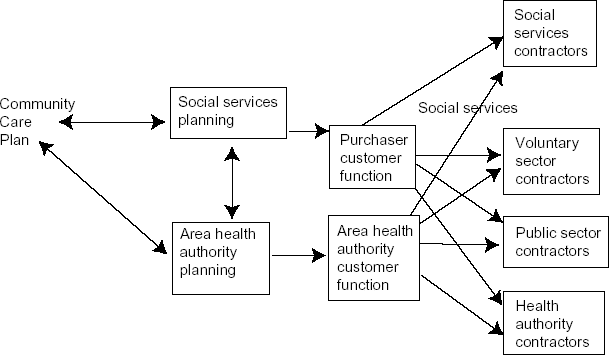
Figure 1: Providing
community care services
You will be able to take your
learning further in this subject by examining the Community Care Plans for
people with disabilities in your local area authority area. These are
available upon request from the social services department or in your main
library.
Session four
The Legal Framework: Part One The Children
Act 1989 and Special Needs
Session Objectives
After completing this session
you will be able to:
- identify
the sections of the Children Act 1989 relevant to special needs
- describe
the principles of the act for all children
- list the
services that the act requires.
Introduction
This session deals with the
legal context of working with children who have special needs and their
families.
The Children Act 1989 received
royal assent in November 1989, and was implemented on 14 October 1991. The
act does not refer to children with special needs, but instead talks about
children with disabilities. You will have begun to consider these terms in
Session One.
It is useful to begin a
consideration of the legal context with our ideas of what the law should do.
As a result of the Children Act 1989, what does the local authority have
to provide, and what can it provide? The next activity should help
you to reflect further on this.
|
Activity 15
|
This activity should take
you about 20 minutes.
Imagine that a child with
a physical disability is a member of your family (she or he may be your
birth child, or a relative). If you have difficulty in imagining a child,
you may use the following example.
Katherine is ten years
old. She has a spina bifida condition which restricts her mobility. She
attends a mainstream primary school located one mile from her home.
Consider the following
three questions and note down your answers.
-
What would you expect
the local authority social services department to provide for the child
in question and other family members?
-
What must the social
services department provide under the Children Act 1989?
-
What may the social
services department choose to provide under the Children Act?
Do not worry if this feels
difficult because you do not know the relevant legislation. The objective
is to consider, from a family perspective, what the law should mean for
you and your young relative.
Aim to spend up to 20
minutes on this activity.
Comment
Before considering what you
may have noted as services for Katherine and her family, we would like to
make a few points about the Children Act 1989, and the law in general.
If this exercise seemed
difficult, you are not alone. Very few people know what a local authority
social services department should provide for them. This is particularly
so in relation to children with special needs because children, their
families, carers and communities have traditionally looked to health and
education authorities as the prime providers of services.
Until the implementation of
the Children Act 1989 services for children with special needs were
provided under the National Assistance Act. In other words, children with
special needs were seen as disabled adults who happened to be younger! The
Children Act 1989 operates the children first principle which sees
children with special needs as first and foremost the same as other
children but with special needs. This entails locating all social services
responsibilities for children, young people and their families – whatever
their needs – under one statutory roof.
In Unit 3 of the module
Using the Law in Social Work you will have considered the definition of
children in need in terms of the Children Act 1989. Section 17 of the act
defines a child as being in need if he or she is disabled.
The Children Act 1989 mirrors
the National Assistance Act 1948 definition of disability stating that:
… a child is disabled if he is
blind, deaf, dumb or suffers from mental disorder of any kind or is
substantially and permanently handicapped by illness, injury or congenital
deformity or other such disability as may be prescribed.
From the basis of defining a
child as being in need, the local authority is required to provide services
designed to:
In response to Activity 1, you
might have expected the social services to provide, or promote the provision
of:
-
domiciliary and home care
services
-
family centres, for example,
a centre for carers’ support groups
-
day care. Like any child in
need, a child with special needs should be provided with day care,
including after school and holiday care.
-
advice, counselling, and in
special circumstances, financial support
-
occupational therapy
services, including the provision of aids and adaptations
-
transport to and from the
services provided
-
assistance with family
holidays and respite care schemes
-
information about services
provided by both the local authority and other agencies
-
after care and the effective
transition from childhood to adult services
-
a register of disabled
children in their area.
The social services department
has to provide the first service in the above list. In addition they
may provide the rest of the list.
The provision of these services
is based on the principles of the Children Act 1989, including the key
concepts of partnership and representation, which we will now consider.
Partnership and Representation
One of the key principles of
the Children Act 1989 is that of partnership between parents, carers,
children and the authorities that provide services. Families have unique and
special knowledge of their child and his or her needs, and are therefore
best able to identify services that can enable them to carry out their
parental responsibilities. The concept of partnership is particularly
relevant to the concept of a needs-led service, which you have considered in
Session Three. Without partnership, and clear channels for children and
their families to express their views on services, authorities can easily
slip back into providing the services that they consider best for the
service users.
Children with special needs and
their families will only be able to enter a genuine partnership with the
local authority if:
-
service users
are involved and represented in service planning
-
the whole
service – from referral, to assessment, to service delivery, to review and
evaluation – is true to the principles of openness and participation
-
information is
made available sensitive to the various cultural, linguistic and religious
backgrounds of actual and potential service users
-
service users
are made aware of complaints and representation procedures. This is
required under the Children Act 1989 and community care legislation
-
professional
agencies evaluate services within a quality assurance framework to ensure
anti-oppressive practice in terms of race, gender age, sexual preference
and ability.
|
Activity 16 |
This activity should take
you about 20 minutes.
The objectives for this
session refer to the requirements of the Children Act 1989 in relation to
children with special needs. One such requirement, as identified in
Activity 15, is for local authorities to establish a register of disabled
children in their area. The inclusion of any child’s name on a register
held by the social services might provoke a range an anxieties within
families, particularly in the light of adverse publicity concerning child
abuse registers and practices in the past decade. You may recall the names
of children subject to child abuse inquiries, when their names were on ‘at
risk’, ‘child abuse’ or ‘child protection’ registers.
Imagine that you are
employed by a social services department as a social worker in an area
team. You are asked to help set up a task group with the objective of
developing the register of disabled children. How might you go about
developing the register and/or setting up a task group?
The following points may
help you with this activity.
-
What is
the point of such a register?
-
How would
children and their families know about the register?
-
Which
agency or authority should hold the register?
-
Should it
be held on computer?
-
Who
should have access to the information?
-
What
information should be held on the register?
Write down your comments.
Comment
In completing this activity
you might have thought of the following points.
-
discussions with support
groups and voluntary organisations about the purpose of the register and
the most sensitive and effective way to proceed with it
-
liaison with other agencies
– health and education – about the identification of children with
special needs, and attempting to find common definitions
-
decisions about the
location of the register
-
reference to data
protection legislation and issues of confidentiality
-
the production of
information in different languages
-
an awareness that parents,
carers and other family members may have communication difficulties and
needs, and that information should be produced in other formats such as
Braille and audio-cassettes.
Children with Special needs and
Child Protection
In recent years, professionals,
parents and carers have become increasingly aware of the vulnerability of
children with special needs to being abused by adults and other children.
Some children with physical or learning disabilities are prone to accidents
and injury, making it harder to distinguish between deliberate abuse and
non-abuse. The situation for those undertaking investigations – police,
social workers and health workers – is made more complicated by such
children often having communication difficulties. Children with learning
disabilities or communication impairment are particularly ‘soft targets’ for
perpetrators of child sexual abuse in that such children are less likely, or
able, to make disclosures and allegations about the abuse to which they have
been subjected. It is important when working with children with special
needs in any context to ensure that you are familiar with the area child
protection procedures. You should contact your local social services or
health authority for information about the area child protection committee.
(See Unit 7 of this module, for more information.)
|
Review activity |
This activity should take
you about 30 minutes. It asks you to think about the four sessions covered
so far, including this one, in terms of definitions, needs, services and
the law. Please try to complete it initially without looking back to the
previous material.
You may wish to refer to a
text on the law for social workers (for example, Brayne and Martin) and
volumes 2 and 6 of the Children Act Guides.
Situation study
You are a duty social
worker in an area office. Mr Thomson comes into the office. He is an
assistant bank manager who has been transferred to the area. His family
will be moving here soon, and he wants information on what help the
department will be able to give his son Mark who is 11 years old,
partially deaf and with limited vision. Mark’s primary form of
communication is through signing but quite a few of these signs are only
understood by his parents.
-
How would you respond to
Mr Thomson?
-
What services should and
could the department provide?
In answering the
questions, you will need to ask yourself the following questions.
Comment
You should have noted some or
all of the following points.
-
Within the
terms of the Children Act 1989, Mark is a disabled child and therefore a
child in need.
-
Mark and his
family are therefore entitled to family support services as set out in
Part 3 of the Children Act 1989.
-
Mark is the
primary client, as Section 1 of the Children Act 1989 states that the
welfare of the child is the paramount consideration.
-
However, Mr
Thomson and his family are also clients, as local authorities have a
duty to promote the upbringing of children by their parents.
-
You should
find out from Mr Thomson what services were provided for him and Mark by
the authorities where Mark still lives and obtain permission to contact
that authority.
-
How Mr
Thomson is responded to in this first interview will influence the
future nature of the partnership.
-
You should
discuss the arrangements for assessment to identify needs, and to
determine services required.
You may have found that while
your knowledge of the Children Act has increased, there are some gaps in
your understanding of the law in relation to health, education and other
areas of provision. We therefore move on to these areas in the next session.
Summary
This session has only been able
to touch on some of the implications of the Children Act 1989 for social
work practice with children with special needs and their families. There is
more detailed coverage in the module Using the Law in Social Work.
Session five
The Legal Framework: Part Two
Children with Special Needs and their Protection
Session Objectives
After completing this session
you be able to:
- identify
what services must be provided by law for the education of children with
special needs
- demonstrate
an understanding of multi-disciplinary assessment and the statementing
process
- evaluate
policy debates on integration and segregation.
Introduction
This session begins with a
particular focus on the education of those with special needs.
Unlike the personal social
services, which are specific and selective, education is a universal
service. It is universal in that all children, irrespective of their
abilities, needs, circumstances and identities, are required under the
Education Act 1944 to receive full-time education, currently from ages 5 to
16. The local authority has a statutory duty to provide education for
children with special needs from age 2 to 19, and in some circumstances may
provide continuing education until the age of 21.
Following the 1978 Warnock
Report, the Education Act 1981 determined that children with special needs
should, wherever possible, be educated within mainstream schooling. LEAs
must provide schools sufficient in number, character and equipment to
offer an appropriate variety of instruction and training for pupils of
different ages, abilities, and aptitudes. In particular, LEAs must have
regard to the need for securing that special educational provision is made
for children with special educational needs.
Section two of the 1981 act
states that the objective is for all children to be educated in ordinary
schools, while allowing for some circumstances in which segregated special
schools will be retained. The act gives LEAs the duty to identify, assess
and provide for those children and young people with special needs.
|
Activity 17 |
This activity should take
you about one and a half hours. It begins by considering your own personal
values, and those of others, in relation to the integration of children
with special needs in schools.
Task 1 Your own attitudes
Consider the four questions below in relation to either a school attended
by your child/children, or a school you know well, perhaps in your
neighbourhood. Note down your answer.
-
How many children with
disabilities, handicaps or special needs currently attend the primary
school used by your child?
-
To what extent would you
like to see the integration of children with special needs and
disabilities (for example, children who are mentally handicapped are
wheelchair users, or are blind or deaf) in the school that your child
attends/children attend.
-
If integration were to
be adopted as a policy, is the school able to accommodate children with
special needs? Is the school accessible?
-
What do you think would
be the attitude of the following groups of people to such a policy:
l
teachers
How would your children
react to having children with special need in their class?
Task 2 The attitudes of A N
Other
Interview a friend, relative or neighbour whose child or children attends
a local school, using the same four questions.
Task 3
Compare your own reactions to the questions with those of the person you
have interviewed.
Task 4
Try to note down key points for and against the integration of children
with special needs in mainstream schools.
Comment
You might have been surprised
– positively or negatively – by your own reactions and those of others.
Ideas such as the presence of children with special needs holding back the
other pupils may have come to the surface.
Now let’s consider the cases
for and against integration. Compare what we say here with your findings
from Activity 17.
The case for integration
Benefits for children with
special needs
A small study of 36 children with Down’s Syndrome, half of whom attended
special schools and half of whom attended mainstream schools, indicated that
over two years, the children in mainstream schools made greater progress in
terms of language development, numeracy, verbal fluency and comprehension
(cited in Woolfson, 1991, p118).
Benefits for the other children
Children educated alongside those with special needs develop greater
sensitivity, consideration and awareness.
Benefits for all children
Integrated education – be it in terms or race, gender and ability –
enables all children to develop relationships with people different to
themselves, and to develop attitudes of tolerance and acceptance.
The case against integration
Problems for children with
special needs
Children may experience rejection from other children and lack the
support from children with similar needs and disabilities.
Problems for other children
Other children may develop resentment of the special attention being
shown to those with special needs, and may feel rejected themselves.
Problems for all
In the context of changing demands in education, teachers may feel under
pressure to take in children for whom they are unable to provide an adequate
service.
Parents of children with
special needs may feel isolated and miss the valuable support networks that
tend to develop around special schools.
Levels of integration
Many different points may have been made in your discussions for
Activity 17. It might be helpful now to group these into three different
levels of integration, as follows:
-
locational integration – when
a special unit or class is located on a mainstream school campus
-
social integration – as
above, but allowing for planned and desired integration at playtime,
school meals, social activities, etc.
-
functional integration –
where children with special needs participate as full and equally valued
members of the school in all its aspects, supported by appropriate
staffing, adaptations and resources as required to meet such objectives.
Where
are children with special needs educated?
14% of the total school population have identified special needs met
within their ordinary school.
0.8% to the total school
population receive additional help from the LEA in their ordinary school or
from a special unit within the school.
1.3% of the total school
population attend a special school or special boarding school.
Children with Special needs and
their Education – what is the Relevant Legislation?
Local education authorities
have long held the primary responsibility for educating children with
special needs. Education is a genuinely universal service in that:
-
all children
are entitled to it
-
all parents
are required by law to ensure their children receive it
-
the education
authority is required to provide education appropriate to the needs of
each child.
We will now move on to
considering how the education of children with special needs is assessed and
provided.
The assessment and provision of
education for children with special needs
The Education Act 1981 ended
the previous system of categorising children according to their handicap,
and replaced this with the concept of special educational needs. A
child has special education needs if he/she has a learning difficulty which
calls for special educational provision to be made for him or her. There is
no sharp division between ordinary pupils and those with ‘special needs’.
Special educational needs are the outcome of the interaction between the
strengths and weaknesses of the child, and that child’s educational
environment.
The Education Act 1981 has been
superseded by the Education Act 1993, which contains a code of practice on
special educational needs.
A ‘learning difficulty’ means:
or
|
Activity 18 |
This activity should take
you about 20 minutes.
Compare the definition of
a disabled child from the Children Act 1989 (See Session 4) with the
concept of special education needs from the Education Act 1981. Note down
the similarities and differences.
Then think about whether
the two apparently different definitions could result in more or less
children being entitled to particular services. How can educationalists,
social workers and health workers work in partnership, using different
legislation?
In considering your views
on the two pieces of legislation, you will need to draw on the materials
in Session One on concepts and language, in particular the terms
‘disabled’ and ‘special needs’.
Comment
Many educationalists,
including educational psychologists, have been dismayed by the use of a
50-year-old definition of disability in the Children Act 1989. The major
differences are as follows.
The Education Act 1981
definition is a relative concept. In others words, while standards of
attainment and achievement evolve in our society, some children will
continue to have relative special educational needs. The Education Act
1981 therefore thinks of handicap in terms of relative disadvantage. By
contrast, the Children Act 1989 definition focuses on absolute conditions
– children are disabled by virtue of their disability. The definition in
Session One therefore focuses on impairment and disability.
The Education Act 1993 (Code
of Practice for Special Educational Needs) assumes that up to 20% of
children – one in five – may have special educational needs at some point
during their school years. It expects that the provision for such children
will be in mainstream schooling unless this is not appropriate.
We now need to consider the
process of identifying special educational needs, meeting those needs and
delivering them. This process is set out in the Education Act 1993 Code
of Practice.
Assessment and the statement of
Special Educational needs
The assessment process for
special educational needs is in five stages.
Stage 1: The teacher
identifies a problem or need and designs a programme for the child, in
consultation with the school special needs coordinator.
Stage 2: The special needs
coordinator in the school takes the lead in gathering information and
coordinating action.
Stage 3: The school refers
to the LEA for assistance, and may involve an educational psychologist, or
other support services, to assist, advise and re-design the programme.
Stage 4: If the school
cannot meet the identified need, a multi-disciplinary assessment takes place
involving other agencies such as health and social services (under Section
10 of the Education Act 1993).
Stage 5: The local
education authority considers issuing a statement of special educational
needs. If the statement is issued it must provide the appropriate help and
services to meet those identified needs.
The Code of Practice expects
that most needs will be met in the first two stages. School governors will
need to include information in the school’s annual report for parents to
explain how they identify and deal with children with special needs.
Time-scales for the stages noted above are clearly laid down in the Code of
Practice.
The next activity focuses on
the role of the social worker in the stages of assessment for a particular
child.
|
Activity 19 |
This activity should take
you about 30 minutes.
Imagine that you are a
social worker working with a Pakistani family whose second child, a
ten-year-old girl appears to be developing a sensory impairment of
restricted hearing. The family have been notified by the LEA that an
assessment of special educational needs is to be undertaken.
Please note down your
answers to the following questions.
-
What should be you role
as part of this multi-disciplinary assessment?
-
What do you need to know
to undertake this role effectively?
-
What values and
principles of practice should you apply?
Comment
-
Your role
Under the Education Act 1981, LEAs must inform social services
through a nominated officer that an assessment of special educational
needs is to be undertaken. Through the Education (Special Educational
Needs) Regulations 1983, LEAs must seek advice from other agencies and
supply other agencies with copies of representations and views submitted
by, or on behalf of, the parents of the child in question. As a social
worker you may therefore have to balance the roles of taking part in the
assessment and being an advocate for the child and parents throughout
the process. These practices will continue under the Education Act 1993,
implemented from September 1994.
-
Your knowledge
In order to give effective advice it is important to know how the
system works. This requires knowledge of local procedures and of
relevant parts of the Education Act 1993 Code of Practice and,
the Children Act 1989.
-
Your values and principles
The principles of empowerment and advocacy (which we will develop
further in Session Six) are particularly important.
Social workers in partnership
with parents
Now let’s look at some research findings about what parents expect of
social workers.
A number of surveys have asked
parents of children with special needs what they most expect from social
services. A consistent comment that emerges is the expectation of support
from professionals who are knowledgeable about their child’s condition, and
who display a willingness to go and find out about issues.
Similarly, parents and carers
expect social workers to understand the procedures that they, the family,
are engaged with. Parents and carers expect social workers to know how
schools admissions policies work, how schools try to meet special needs, and
the role of the local education authority.
Anti-oppressive practice
In all work with parents you will need to focus on issues of
anti-oppressive practice, with sensitivity towards language, culture and
religion. Questions you will need to address are as follows.
-
Who can act as
an advocate for the child and her family?
-
In accordance
with the Children Act 1989 principles, how are the child’s feelings and
wishes being taken into consideration?
-
To what extent
are the family aware of the appeals procedure?
-
Are the family
able to engage with the process from the genuine position that they, like
all parents, know most about their child and her needs?
Cultural bias in standard
assessment mechanisms
The issue of cultural bias,
based on Eurocentric models of human growth and development, is not confined
to the assessment of children with special needs. We mention this here to
reinforce the requirement for a social worker committed to anti-oppressive
practice to challenge and question the assumptions being made in any
assessment system. For example:
-
Are the tests
being used to assess the child’s ability able to recognise cultural
difference?
-
Do the child
and her/his parents understand the process of assessment itself?
-
Are the
professionals involved practising in an anti-oppressive manner by avoiding
jargon, acronyms and confusing language?
The health system: working with
community care
Like the education system,
health is a universal service. For the parents and carers of children with
special needs, various health professionals will be the first agency
contacts, particularly for children with special needs identified from birth
or in infancy. Midwifery and health-visiting services may identify
development difficulties and thus engage the specialisms of paediatricians
and other consultants.
The health system practises
child health surveillance, with the following five functions:
-
the oversight
of the health and physical growth of children
-
monitoring the
developmental progress of all children
-
providing
advice and support to parents or carers, and referral of the child to
appropriate agencies
-
providing an
effective immunisation programme against infectious diseases
-
encouraging
parents to participate in health education and training for parenthood
programmes.
(For further reading on child
surveillance, see the Court Report of 1976).
It is essential to become
familiar with the Community Care Plan in your area, to focus on services for
children with special or additional needs.
Working Together and Coordinating
Services
We have now established that
the three primary agencies for children with special needs and their
families are health, education and social services. Now let’s consider how
these three organisations work together. Child protection agencies with
their own bureaucracies often experience difficulties in liaison and
cooperation – always to the detriment of service users.
Inter-agency cooperation: the
requirements
Section 27 of the Children Act 1989 makes it a formal requirement for
all key agencies to work together to promote the welfare of children. It is
worthwhile noting the nature of these inter-agency responsibilities.
District health authorities
have duties to inform LEAs of any child under five years of age who might
have special educational needs.
Like social services, health
authorities contribute to the multi-disciplinary assessment process towards
the statement of special educational needs.
The function of coordinating
inter-agency services lies in practice with the health authority and social
services department as part of community care planning under the NHS and
Community Care Act 1990.
The Disabled Persons Act 1986
requires social services departments to assess young people with
disabilities for a range of services at the time they leave school, as
outlined in the Chronically Sick and Disabled Persons Act 1970.
The Children Act 1989 empowers
social services departments to combine assessments under the Children Act
1989 and the Chronically Sick and Disabled Persons Act 1970.
|
Activity 20 |
This activity should take
you about 30 minutes.
Using one of the situation
studies in Appendix 1, try to answer the questions that follow.
- What legislation would
impact on the child and family in the case study?
- Which agencies would be involved?
- What would they have to do?
- How would agencies have to work together?
To answer these questions,
you will need to refer to the lists of agencies in Session Three and the
material on legislation in Session Four and this session (Session Five).
Comment
Your answers will depend upon
your choice of situation study. However, all four children used in the
situation studies have things in common. They would all:
-
be defined
under the Children Act 1989 as disabled and therefore as children in
need. The children and their families would therefore be entitled to
family support services under Part 3 of the act.
-
be eligible
for inclusion on a register of disabled children.
-
have special
educational needs and could be the subject of a Statement of Special
Educational Needs. At the least, all the children would need special
needs educational provision.
-
be entitled
to specific health services depending upon their specific impairment and
condition.
-
receive
services from education, health and social services.
A multi-disciplinary assessment
and coordination of services would therefore be required by all of the
children and their families. All of the carers or parents of the children
will have needs of their own – as will the children’s siblings. We will
return to this theme in Session Seven of this unit.
In the case of all of these
children and their families, the role of networks, support groups and
voluntary organisations should be considered.
Transitions to Adulthood
We need to consider transitions
to adulthood for one major reason: research studies have shown that agency
cooperation and coordination can be inefficient when people with special
needs cease to be ‘children’ and become seen as ‘adults’.
In Session One we suggested
that the transition to adulthood for most children is defined more in terms
of informal events such as leaving school or getting a job, rather than
through a formal rite of passage or upon reaching a specific age. Our
society tends to define maturity in terms of increased responsibility. It is
therefore interesting to reflect on who can do what at what age.
|
Activity 21 |
This activity should take
you about 15 minutes.
Try to answer the
questions below, based on the law in England and Wales. The answers are
set out below, so cover them up with a sheet of paper.
At what age can you
legally do the following? Note down your answer next to each question.
|
1. |
leave school
|
r |
|
|
2. |
join the armed forces
|
r |
|
|
3. |
obtain a driving
licence for cars |
r |
|
|
4. |
have sexual intercourse
(heterosexual) |
r |
|
|
5. |
vote |
r |
|
|
6. |
have sexual intercourse
(homosexual) |
r |
|
|
7. |
drink alcohol in a pub
|
r |
|
|
8. |
have a lesbian
relationship |
r |
|
|
9. |
own a shotgun
|
r |
|
|
10. |
buy a pet
|
r |
|
|
11. |
live in or enter a
brothel |
r |
|
|
12. |
have a part-time job
|
r |
|
|
13. |
be convicted as a male
of rape |
r |
|
|
14. |
drink alcohol at home
|
r |
|
|
15. |
drink alcohol with a
meal in a restaurant |
r |
|
|
16. |
get married with
parental consent. |
r |
|
Comment
The correct answers are as
follows:
(1) 16, (2) 16 (with parental
consent), (3) 17, (4) 16, (5) 18, (6) 18, (7) 18, (8) 16, (9) 14 (under
supervision from someone over 21), (10) 12, (11) 16, (12) 13,
(13) 14, (14) 5, (15) 16 (16) 16.
We consider scores of 13 or
above to be exceptional. As this exercise only took a few minutes, you may
wish to try it with two or three colleagues or friends to see how far the
answers are consistently right, or wrong.
You may find it hard to
detect any logic in these age barriers. If you knew that the age for
driving was 17 you would think that an older age was required for the
possession of a gun.
Furthermore, these age
barriers vary in other countries. In Scotland, people may marry at 16
without parental consent. In Greece, girls may marry 14 with parental
consent – four years younger that Greek boys/men. In Italy, children may
leave school at 14. In Luxembourg there is no lower age limit for criminal
responsibility- which is ten in England and Wales and 18 in Belgium.
The age of majority – being
seen legally as an adult – is 18, although you can’t be an MP in the House
of Commons until the age of 21.
The picture for those with
special needs is no less illogical or confusing.
Transitions to Adulthood:
Practice Issues
Services and transitions
For the child with special needs and her/his family, the transition to
adulthood stands as a major life change. It may involve changes in services
and entitlements. Leaving school may involve separation from people and
services that have been long cherished, and moving to a day centre with
different arrangements, new staff, new relationships.
Managing change
As you will note from your own experience, some people welcome, cope
well with and actively seek out new challenges, while others find such
changes threatening, unwelcome and confusing. As a social worker, working
with people experiencing change is often a vital task. We would therefore
like you to look at your own mechanisms for coping with change in the next
activity. This will help you to work more effectively with others who are
facing changes.
|
Activity 22 |
This activity should take
you about 20 minutes.
-
Head four separate
sheets of paper as follows:
1. 0–6 years, 2. 7–11 years, 3. 12–17 years, 4. 18–21 years.
-
On each sheet of paper
list up to four significant life events that you remember from that era.
-
Then note any specific
difficulties that you associate with each event.
-
Lastly, try to remember
what happened to make things better.
For example, on the first sheet, 0–6 years you may put:
Going to school for the first time.
- Being away from mother.
- Frightened of the teacher.
- Hating the food.
- Better when taken to school by mother
or best friend.
- Took packed lunch. Just got used to
it.
Comment
If you have had traumatic
events in your childhood, this may have been a difficult and painful
exercise, but it is worth noting the contributions made by people who have
experienced trauma and loss to the support and assistance others (the
mother of missing estate agent Susie Lamplugh being a good example).
Surviving difficulties is a common motivator to helping others.
However, apart from your own
experiences, you will need to recognise how people from different cultures
and backgrounds perceive and cope with events and life changes.
Helping other people prepare for
change
Our focus so far in dealing
with change has included your own experiences and the impact of change on
other people. We now move on to consider the social work skills required for
taking a proactive stance in helping others prepare for change.
|
Activity 23 |
This activity should take
you about 20 minutes.
Please begin by reading
the following situation study.
Frank is 18 and has been
at a residential special school for the past 12 years. He has epilepsy and
has periods of seizures (or fits), which effect him severely. The effects
include: falling and injury, long periods of sleep in recovery, and
short-term memory loss. Most of the time his condition is controlled by
medication and he can lead a reasonably independent life. Frank wishes to
seek employment but in the short term attends a local day centre. He has
just been allocated a flat in a housing association unit, but it is in an
area of the city with which he is not familiar.
You are Frank’s social
worker. What would be your plan of action to work with Frank through the
changes facing him and his family?
You should aim to write
down up to six specific ways you would help Frank make the moves required.
You should put your thoughts under various headings such as Work, Day
Centre, Home (family), Home (flat).
Comment
A key part of your plan will
have involved preliminary visits to both Frank’s home and the day centre.
You might also have taken Frank to the housing association complex and the
neighbourhood to begin familiarisation. Frank’s parents may have their own
difficulties about accepting his desire for independence, and these need
addressing. As a result of being at boarding school, Frank may have few
links with young people in the area. These networks need to be worked on
early, as support from people his own age will be vital for Frank.
Defining your role and that of the workers at the day centre is important
to avoid duplication and confusion. Although Frank, as the young person,
has to be your primary focus of work, we suggest that you need to consider
his whole system.
Summary
We recognise that this has been
a long session, focusing on aspects of legislation and moving on to look at
services for adults as transitions from childhood occur. We now wish to look
at how services to people with special needs are seen by others in society.
This will have a major impact on the effectiveness of the services in
combating the oppression and experienced by children and young people.
Session Six
How Services to Children with Special Needs and Their Families
are Viewed
Session Objectives
After completing this session
you will be able to:
- specify how
services are seen by the community
- identify
the impact of such images on the life chances of services users
- undertake
an initial evaluation of a service in your area.
Note: Activity 25 will involve
you visiting a centre providing services for children with special needs.
Introduction
For the past 20 years providers
of services to people with disabilities or special needs have been
influenced by the theory of normalisation. We do not propose in this
unit to go into great detail about the principles of normalisation; you will
find a detailed treatment in Unit 4 of Social Work in Community Care.
However, John O’Brien refers to five goals that services should aim to
achieve for their users. We describe these on the next page.
-
Presence in the
community – using ordinary services as ordinary citizens.
-
Ensuring choices –
supporting the preferred options of people.
-
Developing competence
– people acquiring meaningful and valued skills
-
Promoting respect – by
developing and maintaining positive images.
-
Ensuring participation
– by empowering people to control their services and developing networks
of relationships.
We will now move on to
considering what these principles of normalisation mean in practice.
|
Activity 24 |
This activity should take
you about 20 minutes.
Referring back to the
situation study in Activity 23, try to complete this activity about either
the housing association flat Frank is to move to, or the day centre he is
attending.
Compile a list of the
features of the housing complex or the day centre that would contribute to
the service being seen as deviant, different or devalued by the rest of
the community. Imagine that Frank’s services are in your neighbourhood.
What features of appearances would make these services stand out as
different and be seen in a negative light? An obvious example would be if
a service centre had bars on the windows, looking like a prison.
Try to think of six such
negative features.
Comment
Your list will probably be a
mixture of the obviously negative – such as the example given – and the
more subtle. A sign outside a residential home, mini-buses with ambulance
signs, or ‘donated by’ acknowledgements, all suggest images of dependence,
sickness, charity and separation.
High fences that stand out
from neighbouring buildings, disrepair of the buildings, and a location in
an undesirable area are all answers you may have given. Even more subtle
is the continued location of services on sites with very negative
associations. In our work in this field, we have encountered day centres
for people with learning difficulties and a unit for elder people being
located in former workhouses.
Evaluating a Service
In order to get the ‘feel’ of a
service centre, it is important to visit such an establishment as an
observer.
|
Activity 25 |
This activity should take
about two hours. On-site research should take no more than one hour.
We would like you to visit
a centre that is providing services for children with special needs. This
could be a special school, a residential or day centre or a respite care
centre. If this is not possible or too far away, the activity can be
carried out with a service centre for adults: a residential home for elder
people or a day centre for people with physical or learning disabilities.
Use the questionnaire you
will find in Appendix 2. The activity does not require you to enter the
building or interview anybody who uses the service.
Along with your evidence
from observation, you should add further evidence by asking the questions
of local residents and shopkeepers. For this you should use Part 2 of the
Appendix, entitled ‘Local views of others’.
You could carry out this
activity at your convenience. In the meantime, continue with the session
following the comment section.
Comment
We hope you have found this
activity useful. As social workers, we often have to rush into service
centres and become caught up with our own objectives to attend a meeting
or interview a service user. We rarely take time to think about how the
service is viewed by others. When we have undertaken this exercise, we
have often noted the following points.
-
Signs
outside buildings are useful pointers to potential service users, but
may be demeaning or stigmatising.
-
Very few
establishments are located in places in which we would choose to live or
work.
-
The
buildings themselves rarely blend into the architectural tone of the
neighbourhood.
-
In some
local authorities, all establishments are of a certain type. For
example, children’s homes were commissioned from one architect and
builder. They all look the same, irrespective of where they are located.
-
Many service
users are still transported to and from day centres in ambulances or in
vehicles with unhelpful logos on the side.
You may have made similar and
comparable observations.
Identifying services and
resources
We now wish to consider the tension between the need to make services
clearly identifiable and the desire to make services discreet and as
‘normal’ and as everyday as possible.
Signs and symbols
In Session 1, we focused on language, terms and labels as an important
area for study in terms of how service users with disabilities and special
needs are viewed. We now wish you to look at the function and impact of
signs and symbols.
|
Activity 26 |
This activity should take
you about one hour.
We hope that by this stage
in the unit, you will have become familiar with services in you area.
Using whatever sources you are able to consult (telephone directory,
service directories, handbooks, guides, information leaflets, etc.)
research and note the names of centres and groups that provide services
for children or adults in you area. This does not need to be confined to
the field of disability or special needs. Then evaluate these names in
terms of whether they convey positives or negative messages.
Comment
This might have been a
difficult exercise, depending upon where you live. Our view is that the
easier it has been to complete in terms of identifying service centres,
the greater the degree of labelling in your area. If services,
particularly residential centres, are quite discreet, the task may be
harder for you but the service may perhaps be better for the
residents/users. Recent trends have been to name homes by the house number
in a street where every other dwelling has a number, instead of naming
them The Woodlands Centre or Beechcroft. One of the most unfortunate and
offensive centres we encountered was named Cripplecraft – a name that has
now been changed. The use of such names is reinforced by the prominent
display of signs outside the buildings, often primarily for the benefit of
service funders, not users.
Messages for and from the
Media
Session Three of this unit, focusing on the Children Act 1989,
referred to the requirement to keep a register of Disabled Children. The
act also requires authorities to publish information about all relevant
services available to children with disabilities and their families. The
dilemma for all service providers is how to produce information that is
dynamic and effective, without drawing upon and reinforcing stereotypes of
dependence and charity. For example, organisations such as MENCAP and The
Spastics Society recognise that their names are now inappropriate and
demeaning, but since they are charities dependent upon voluntary
contributions, the decision to change their name, image or logo would
result in a loss of income and public awareness.
|
Activity 27 |
This activity should take
you about 20 minutes.
Imagine that you are day
service worker in a centre for people with learning difficulties. You and
your team have been asked to produce a logo or symbol for the centre for
publicity materials. Design the logo in picture form. Show your design to
somebody and ask them what they think it represents.
Comment
You will probably have
approached this task in one of two ways. You may have produced a neutral
design with which you feel comfortable – but which meant nothing to your
viewer. Alternatively, you may have found yourself trying to represent the
key terms learning and difficulty in a way that makes sense
to the viewer but which is negative in terms of emphasising difference and
disability.
We are not able to offer any
easy resolution of this dilemma. One response may be to ask service users
how they wish their centre to be portrayed and to give them the facilities
and resources to produce their own materials. You might have a ‘people
first’ group in your area, engaged in such work.
|
Activity 27 |
This activity should take
you about one week to prepare and then 30 minutes to evaluate.
Compile up to ten press
cuttings from local, regional and national newspapers, including pictures,
that refer to any aspects of children with special needs. Write down the
key terms or phrases used by the press to describe children in these
stories, and comment on whether they convey positive of negative images.
Comment
Unless your local press deals
with such issues with an extraordinary degree of sensitivity, the
underlying images will invoke feelings of pity, suffering, bravery, burden
and worthy causes. Reference to children suffering from Down’s Syndrome
are commonplace; families or individuals are tragic and heroic.
Accompanying photographs will feature ‘sufferers’ receiving cheques or
equipment from fund raisers.
You may have noticed a
pattern suggesting a hierarchy of good causes, with some areas of special
needs conspicuous by their absence. Children with special needs are more
newsworthy that their adult counterparts; physical disability gets a
‘better press’ than learning disability.
It is difficult for the media
to promote positive images. It is hard to recognise achievement without
appearing patronising. The media often promote negative images by seeming
to publish only exposure of malpractice, an example being the coverage of
the care of children with special needs in Romania. Such images convey a
range of messages: pity for the children; the despising of those
responsible; and a sense of cultural superiority (it would never happen in
Britain!).
Summary
In this session you have worked
on the structural and cultural issues that impact on the lives of children
with special needs. Referring back to the definitions in Session One, we
have focused on the handicap that people experience, preventing them
fulfilling a role that is normal. We believe that how services are
organised, viewed, see themselves, and the message they convey all have a
profound impact on the service users.
You will now move on to Session
Seven, addressing other parts of the jigsaw.
Session
Seven
Other parts of the Jigsaw Beyond the
Health, Education and Social Services
Session Objectives
After this session you will be
able to:
- identify
the roles of other agencies (beyond health, education, and social
services) that impact on children with special needs
- explain the
significance of welfare benefits and financial support for parents and
carers
- specify the
environmental factors that promote life opportunities for children with
special needs
- evaluate
the needs of parents, carers and other family members.
Introduction
So far in this unit, your
enquiries and thinking will have focused on the identification of needs and
the provision of services by three primary agencies: education, health and –
most significantly, given the nature of this learning programme – the
personal social services.
However, if you as a competent
social worker are to engage with the total needs of children with special
needs and their families/carers, other significant parts of the jigsaw much
be considered. These are:
-
benefits and
welfare rights
-
housing
-
the
environment, access and recreation
-
informal
care/care of the carers
-
the needs of
siblings and other family members
-
employment and
independence.
You will need to visit a
Department of Social Security office or Citizens Advice Bureau in order to
complete Activity 29.
Firstly, we wish to consider
the issues of health in its widest sense, related to class and life
opportunities.
Health and Class
The links between poverty,
impoverished environments and the greater incidence of disease, disability,
and premature death have been well documented in the Black Report:
Inequalities in Health (DHSS 1980). It is important to consider these
links between social class, illness and disability, as social workers need
to understand the structural issues impacting on the lives of services
users.
|
Activity 28 |
This activity should take
you about 20 minutes.
Imagine two children with
the same degree of physical disability related to spina bifida.
They live in contrasting circumstances. Child A is in a professional,
middle-class family; Child B is in a low income working-class family.
In the boxes below,
compare and contrast their quality of life and life opportunities. To
begin with, use headings such as ‘Housing’, ‘Health and the environment’
and ‘Welfare benefits’, adding more if you wish.
Comment
You may have considered some
of the following points.
Housing
Child A is far more likely to live in a house with ground-floor access
which is easier to adapt to his/her needs and which has a garden. He/she
is likely to live in a safer, less polluted environment.
Child B is more likely to
live in a flat or house with poorer facilities and amenities which may be
overcrowded. He/she is likely to live in a polluted or impoverished
environment.
Health
Research in the Black Report shows that middle class parents are more
likely than working class parents to seek and receive appropriate medical
help for their children.
For the vast majority of
families including a child with special needs, financial matters have a
critical impact on the way they function and cope.
Welfare benefits
Many entitlements to benefits are not taken up by potential claimants.
Middle-class families are more likely to engage with a complex and
confusing benefits system and feel able to challenge rulings and
decisions.
We will look at the issue of
welfare benefits in more detail, as financial concerns impact
significantly on the quality of life experienced by all members of a
family containing a child with special needs.
Benefits and welfare rights
For anyone trying to understand any benefit entitlement, the system is
both complex and daunting. Most benefits are not taken up by many people
for whom they are designed. One aspect of the social work task is to
promote the application for benefits by potential claimants.
|
Activity 29 |
This activity should
involve about one hour of research.
It is important that you
gain some experience and knowledge of the benefits to which a family
including a child with special needs could be entitled. You may undertake
this activity at your convenience as it will entail visiting a Department
of Social Security office or Citizens Advice Bureau. Return to the
following comment when you have completed the exercise. In the meantime,
continue with the unit after the comment section below.
Situation study
Simon is 12 years old, the
only child of his parents Jim and Mavis Wilson. He has cerebral palsy and
attends a special education unit attached to the local comprehensive
school. Mr Wilson is unemployed. Mrs Wilson is employed as a dinner
supervisor at Simon’s school.
What are the benefits to
which this family could be entitled?
Comment
Smyth and Robins (1989)
showed that all types of families including a child with special needs
were financially disadvantaged relative to similar families without such a
child. This study alone emphasises the social work role in maximising the
take-up of appropriate benefit entitlements. You should have considered
the following benefits.
For the family as a whole:
income support, housing
benefit, disabled child premium and community charge benefit
For the child:
attendance allowance,
mobility allowance, disability living allowance.
For the parents:
invalid care allowance.
Housing needs
Housing needs are very complex.
For many reasons – community support, family proximity, employment, access
to services and financial constraints – families may choose to stay in
accommodation that on the surface may appear unsuited to the welfare of a
child with special needs.
|
Activity 30 |
This activity should take
you about 20 minutes.
Situation study
Wesley and Sonia Wilson,
an African-Caribbean couple, have four children, the third of whom is a
five-year-old girl who has spina bifida. They live in private rented
accommodation – a first-floor three-bedroomed flat. You are their social
worker and have been told by the housing department that the Wilsons could
be given a council house two miles away. The Wilsons tell you they don’t
want to move.
-
Can you suggest two or
three reasons for the Wilsons wishing to stay in apparently unsuitable
accommodation?
-
What help regarding
their accommodation could be offered by the social worker if they chose
to stay where they are?
Comment
-
You may have thought of the
following reasons why the Wilsons wish to stay where they live.
-
A move
would result in disruption for all family members – distance from
work, schools, clubs, etc.
-
Any
informal support network in their housing area or neighbourhood would
be lost.
-
Many Black
families experience increased racism on some housing estates, away
from their support networks.
-
Any possible adaptations to
their existing accommodation will come under the remit of the Local
Government and Housing Act 1989, Section 114, covering the disabled
facilities grant. The responsibility lies with the local housing
authorities or London boroughs.
Housing and environment concerns are not merely a matter of comfort and
accommodation. They relate directly to safety and the stress on carers.
Children in the Registrar General’s social classes IV and V are far more
likely to be involved in accidents.
Their opportunities to play safely within eye or earshot of their
parents are far fewer that those of their better endowed peers higher up
the social scale. Furnishings, including forms of heating in the house,
are likely to be less safe, as are other domestic appliances which they
encounter.
(DHSS 1980)
According to Glendinning
50% of severely disabled children cannot be left alone and unsupervised
for more that ten minutes at a time.
The Environment, Access and
Recreation
In Session One we used the term
handicapped as meaning the impact on the individual that results from
their disability. The concept of being handicapped by society can
often be best illustrated by considering the extent to which children with
special needs – and by definition, their families – are denied access to
facilities considered by most of us to be an essential part of community
participation.
|
Activity 31 |
This activity should take
you about 30 minutes.
In Session Six you
evaluated specific services for children with special needs. Now we want
you to evaluate general services and resources available to all children.
Apart from accessibility,
think about whether your local facilities positively encourage and welcome
children with special needs.
Draw up a list of the
community facilities that you, as an actual or imagined parent, might use
in an average year. Such a list may include such things as: school, health
centre, swimming pool, sports centre, cinema, shops, bus station.
Alongside the list,
identify which of these facilities would be easily accessible to a child
with a physical disability.
Use the following
headings.
Facility
Accessibility
Comment
Comment
Little or no comment is
required here. Your list should be evidence enough of the extent to which
public places are often public only for able-bodied people in society.
Informal Carers and Care of the
Carers
As with the great majority of
children, the bulk of caring for children with special needs is undertaken
by women, with little or no help from other family members. Studies have
shown that 61% of women caring for a disabled child do so far at least 50
hours per week. The presence of a person with special needs seems to
reinforce patterns of family care rather than change or challenge them.
Wilkin (1978) reported that the fathers’ roles in most families with special
needs children varied little from the dominant cultural pattern. More
recent studies (Glendinning 1985) have found that, as in most studies of
child care and domestic labour, fathers’ activity centred on the more
rewarding and pleasurable aspects of parenting – not the routine and
domestic.
Where women, as primary carers,
get support from outside the immediate household, this tends to come from
other women in the extended family, the neighbourhood or from support groups
comprising mothers of children with similar special needs.
Last Pieces of the Jigsaw: the
Needs of Siblings
Glendinning’s study (1983)
showed that older children were often an important source of parental
support which may detach them from socially and culturally expected
childhood experiences. Studies of families including a child with either
cerebral palsy or spina bifida found that 75% of siblings over seven years
of age were expected to help in a large range of basic care activities.
|
Activity 32 |
This activity should take
you about 20 minutes.
Refer back to the
situation study in Activity 30 concerning the Wilson family. The girl with
special needs, Simone aged five, has three siblings, Samuel aged 14,
Gloria aged eight, and Malcolm aged three.
What might be the feelings
and reactions of these three children towards their sister Simone?
Consider also the
relationships between these siblings and their parents.
You should note down your
thoughts under headings for each child.
Comment
Siblings may often feel
resentful and neglected. They may be subject to very high expectations:
moral expectations about being a good, considerate, caring child;
educational expectations, to achieve for two, and to be above average to
make up for the other child’s’ perceived deficiencies; recreational and
sporting expectations, as with education.
You may expect the three
children to have different reactions. As with any family, there will be
different gender expectations in relation to the children. Gloria may be
expected, as a young girl, to share with the mothering or domestic
routine. Samuel may be under greater pressure to be responsible and to act
as a mini-adult. Malcolm may feel displaced as the youngest child, and
feel neglected by his parents. To meet Simone’s needs, Samuel and Gloria
may be expected to take a greater part in caring for Malcolm.
Siblings may also be subject
to over protective attitudes from parents and carers, based on the fear of
accidents, and other life risks.
Employment and Independence
In 1977 a survey conducted by
The National Children’s Bureau identified an unemployed rate of 19.1% among
disabled school leavers, compared with 4.4% among school leavers generally.
Given the much higher level of national unemployment today, the current
figure for disabled young adults would be much higher.
|
Activity 33 |
This activity should take
you about one hour. You may be able to draw upon some information and
material collected for previous activities.
Identify the employment
and educational facilities and schemes for young people with special needs
in your area. Note down your information against the following list of
facilities. You should be able to find out about:
-
sheltered
placement schemes
-
employment rehabilitation units
-
sheltered
workshops
-
social
education centres for people with learning disabilities
-
employment training schemes
-
courses
in further education colleges
-
youth
training schemes
-
access to
higher education.
Comment
The issues of employment
opportunities in your area are complex and controversial. Centres for
adults with learning disabilities have shifted their orientation in recent
years from employment to education and life-enhancement. Legislation
designed to require employers to employ a percentage of people with
disabilities has not been enforced. Some local authorities have employed
access officers to promote the employment of people with disabilities.
Summary
In this session, you will have
considered the often overlooked but important factors that impact on the
lives of children with disabilities, their parents, carers and siblings.
Much of the material in this and other sessions has focused on the
underpinning knowledge and values that inform social work practice with
children with disabilities, and their families. In the final session you
will address the practice issues of beginning and ending work.
Session
Eight
Beginning Work, Ending Work
Session Objectives
After completing this session
you will be able to:
- identify
the process of assessment
- explain
where assessment fits in with the social work task
- identify
different types of assessment.
Introduction
From birth through adulthood
the child with special needs and his/her family can come into contact with
numerous professionals including doctors, therapists, nurses and social
workers. As the different services become involved in care of the child and
support of the family, continuity of care and collaboration between agencies
can become difficult. Virginia Bottomley, as Secretary of State, spoke of
the challenge of providing a seamless service based entirely around the
needs and wishes of users of care and their carers. In this session we
consider the social workers’ roles as they begin to work with children and
their families at various stages in children’s lives.
Beginning Work
Work with a child with special
needs and his/her family of carers begins at the point of a referral. The
referral will either be from another agency (often education or health) or
from the service users themselves. You have already considered how the image
of a service – its name, publicity materials and environment – affects the
relationship between service users and professionals that will follow. The
process of assessment commences from the beginning of contact.
Assessment
The first thing to note about assessment is that it does not exclusively
happen to the users of social services, nor is it peculiar to social work.
In Session Five, for example, we looked at the process of assessment in
education. At some time we are all subject to a form of assessment, be it a
job interview or application to a college course. Within social work, formal
assessment is used in different ways to enable the social worker to carry
out specific functions, and we shall go on to explore some of these in
detail.
Assessment of needs and
strengths
In this approach, statements about people’s needs for assistance are
balanced by statements about what they can do for themselves. This can help
move away from a model of disability in which the focus is on the incapacity
of the individual (as described in Session One). Thus, needs are
specifically identified but so too are abilities or achievements. As an
example, a person’s need could be described as requires help with feeding,
although a strength could be can grip a spoon. These statements are
seen as more helpful than the deficit approach of describing the
person as being unable to feed his/her self. Similarly we might find a
client described as needing assistance to develop his speech, but able to
make needs known by gestures and signs.
The following activity is
designed to show how such an approach can be used to provide the basis of
working with a family.
|
Activity 34 |
This activity should take
you about 20 minutes.
From the description of a
child with special needs given below, compile two lists of what you
consider to be his strengths and needs. A single page should be sufficient
for your list.
Tom is nine years old but
is functioning more at the level of a three-year old. He lives in a
children’s home. He displays a number of behavioural problems and has
little speech. If he wants anything he can be very annoying to the staff
by dragging them to what he wants. If he want to go out, he gets his coat
and stands by the door, and screams if he can’t get his own way. When
another child has something that he wants he will take it off them but he
can be helpful with children who have additional physical disabilities.
Tom is generally very noisy and boisterous but when he gets the attention
of staff, he can be very affectionate and kept occupied for a reasonable
period. Although he can be spiteful to others, he has an endearing smile.
Comment
In compiling your strengths
and needs list, you have probably found it easier when focusing on the
positive comments. However, by referring to needs, instead of deficiencies
or problem behaviours, you can work towards a more constructive and
optimistic description. For example, translating the comment screams if
he can’t get his own way into needs to respond to others without
screaming adds a more positive dimension, suggests a task that should
be carried out (i.e. teaching the appropriate skill), and resists the
temptation to blame the child and define Tom just in terms of problems,
which is unhelpful. In a similar war, dragging them to what he wants
can be seen as a strength in being able to make his needs known.
Overall this approach can be
helpful in clarifying problems and suggesting ways of working. This can be
particularly useful when dealing with difficult behaviours. When such
behaviours are in evidence, it is our experience that they often tend to
be reported or recorded by parents or workers in inaccurate or very
unhelpful ways. The types of descriptive phrases that are used include
those which label behaviours as being manipulative, attention seeking,
stubborn, or just simply bad. By using a strengths/needs list, you, as a
social worker, can help carers and others working with the child and
family to describe what the behaviour is rather than suggesting why it is
being used. This can then be the basis of planned intervention in a way
that is both positive and client-centred.
Individual programme planning
Assessments are rarely, if ever, used in isolation. Specific forms of
assessment are often used in conjunction with others. For example, an
assessment of disturbed behaviour undertaken by a psychologist could link
into a functional assessment by an occupational therapist that focuses on
specifics such as self-help skills. This helps to build up a wider picture
of an individual. Many social services departments use an assessment
framework called Individual Programme Planning (IPP). The rationale for this
approach is that while many children and young people with special needs are
resident in group care settings, or attend day care centres, the goal of
work is to meet individual needs and to promote individual strengths.
Individual Programme Planning:
the process
The IPP system works in the following way.
Identify individuals
Although some schemes aim to include all groups, a common starting point
is to target or prioritise individuals. These might be children with special
needs who are likely to encounter major moves or changes, such as the
school-leavers we discussed in Session Seven.
Identify staff
Because a number of staff from different agencies are likely to be
involved, it is helpful to appoint one person specifically to coordinate
this process.
Gather information
If you are the worker coordinating the IPP process, you should gather
information about skills such as communication, and activities such as
leisure pursuits.
IPP meeting
When the IPP meeting is held other key people should attend as well as
the service user and carers. Here particular goals or objectives should be
set for a specified period and priorities should be agreed, with the person
responsible for each action recorded (for example, ‘Arrange for attendance
at a local swimming club and arrange transport – social worker.’).
Monitor and review
You should check on the progress of outcomes and the satisfaction of
clients. The key to this process should once again be the user. It should be
his/her IPP and not the property of the staff; something as far as possible
done with rather than to the user.
How to gather information
As a way of gathering information, assessments can be used to measure
ability. In the following activity, we look at some of the methods that
might be used to obtain the required information, and some potential
problems involved.
|
Activity 35 |
This activity should take
you about 30 minutes.
-
First read the following
situation study.
Mary
Mary is seventeen years old, and for the past two years has been living
during term time at a residential school for children with learning
difficulties. During school holidays she spends some time with both
parents (who are separated) and some at a short-stay children’s home.
You have just been appointed as her social worker. Your predecessor had
not had a great deal of direct contact with Mary as the involvement had
been confined to finding her existing placement after her family moved
into the area, and then attending case reviews. From the case notes you
find that Mary is described as having a mild learning difficulty, but
because she is reasonably socially competent it is easy to overestimate
her competence. She tends to say that she can do things that she does in
fact have difficulties with. She can read a little and write her own
name and address.
-
Imagine that you are the
social worker trying to place Mary in a residential home. The manager of
a home wants to know what she can do for herself, and what she needs
help with. It is your role to obtain this information as soon as
possible so that you can see if Mary meets the admission criteria.
List up to four possible
ways to obtain the information, and make a note of what type of problems
there might be for each method.
Comment
The main methods that you
have considered probably included some of those that follow.
-
requesting
written reports from the school
-
requesting
written reports from the short-stay home
-
interviewing
staff from either unit direct
-
interviewing parent(s)
-
observing
Mary
-
completing a
check-list.
You will have also probably
noted that in practice you would need to use more than one of these
methods in order to build up a more complete picture and to help check the
consistency of the information.
Of the potential
difficulties, you may have recognised issues such as:
-
relying on
others to provide information
-
report
styles and accuracy
-
inflexibility of checklists
-
the
reliability of Mary’s answers
-
how best to
effectively observe
-
whether to
use formal assessment checklists or whether to create your own.
Practice principles
The outcome of the social worker’s task in carrying out an assessment
will depend on how is it is undertaken as well as what is done. In the case
of Mary, for example, although the problem of her not always answering
questions accurately has been recognised, it would still be reasonable
(indeed sound practice) to involve her as far as possible – carrying out an
assessment with her rather than on her.
It is also worth mentioning
here the specific role that we identified for you as the social worker in
the work with Mary. We placed the task within the context of finding a
residential placement, a role that very much fits in with purchasing
services. Once again, the way in which this process actually works varies in
different localities, depending on the way in which social services
departments are organised. Of the particular model that we used, you will
have seen that although its basis was that of purchasing a service – in
Mary’s case a residential home – the social worker’s role also involved
providing a service, namely an assessment. In you own area it may be the
case that the assessment would be carried out by someone called a care
manager or an assessment officer.
The check-list approach to
assessing independent living skills
In the previous activity we introduced the idea of a check-list approach
for assessment. This is commonly used and is seen as a useful way of
identifying specific skills to be assessed and measuring competence. As a
social worker you could use such a method in a number of ways. In the last
activity, for example, you might have used a check-list to assess Mary’s
level of skill in order to clarify the level of support needed and the
appropriateness of the service – which in this case was the residential
home. This method could also be very helpful in giving an information base
to assess the level of potential risk, and with this in mind we feel that
you will find the next activity helpful. (In both of these exercises we use
situation studies which reflect some of the issues relevant to the
transition from child to adult services discussed on Session Five.)
|
Activity 36 |
This activity should take
you about 20 minutes.
In the previous exercise,
we focused on the methods of collecting information for assessment. We now
turn to the content of the assessment.
You should complete both
parts of this task in this activity and the next one.
Read again the situation
study of Mary in Activity 35 and then list up seven or eight general
heading that would be helpful to assess (for example, basic education).
Comment
The list that you compiled
should have included some of the following headings.
person or self
care mobility
basic education
communication
relationships
domestic
leisure
work
independent or community living skills
You may well have used
different headings or found that some of them overlap. We would be the
first to admit that not all of our own headings are exclusive or equally
clear. For example, ‘communication’ is clearer than ‘community living
skills’. Some of the headings can cover a wide range of skills while
others may be more focused.
You will have considered how
general or specific your own headings should be, perhaps differentiating
between different types of mobility, one involving basic skills like
‘walking unaided’ and ‘propelling one’s own wheelchair’ and a second
covering of the use of transport and road safety.
Whether your headings were
broken down into more specific or general headings, either approach is
perfectly valid, as is the use of other headings such as social skills. In
our experience many different headings are used in the various published
assessment lists; so don’t worry if your list looks very different to ours
– you’re in good company.
Whatever headings are used it
is important to remember that these are merely pointers. The test for how
useful they are will be found in what comes under them, which is what we
now turn to.
|
Activity 37 |
This activity should take
you about 20 minutes.
Choose one of your
headings from Activity 36, and then list between ten and 20 specific
skills that you would identify to be assessed, for example:
-
basic
education
-
telling
the time
-
reading
signs (entrance, toilet, poison, closed, etc.)
-
writing a
simple letter
-
counting.
Comment
You probably again found
yourself considering the level of detail that you needed to cover, and how
specific you needed to be. As you can see from our list above, we have
taken a very general approach rather than a specific one. We could have
added specific details such as telling the time to within 15 minutes, or
counting up to ten or 100.
You may have found it a
useful starting point to focus on activities that are very familiar to
you, and perhaps been surprised by the amount of skills involved. If you
had selected a heading covering independent living skills you could easily
have identified up to 20 specific skills just on the activities involved
in getting up, getting ready and going out in the morning.
Whatever the degree of detail
you included, we believe that in practice it is useful to start at a more
general, mid-point. You can usually return for more detailed work if
necessary.
Ending Work
So far in this session we have
concentrated on receiving referrals as a social worker and using the
assessment process as a way of identifying needs – and therefore assessing
the extent of support required. But if you are to meet the demands of new
clients the question arises of how work with existing clients should finish
to make room for them. It is to this question that we now turn.
A Task-Centred Approach to Social
Work
An effective way of concluding
work is through a task-centred approach. Here, as a social worker, you would
aim to identify specific tasks when engaging in work with a client rather
than just build a relationship under the umbrella of offering ongoing
support. The agreed tasks could then form the basis of an agreement that
clarifies the nature of your involvement. This can be extremely helpful to
all parties. After all, if you put a car in a garage to be serviced you
would not thank the mechanic if he or she decided to respray the vehicle as
well. By using this method, you can effectively end work as you begin it.
To illustrate how this works,
the next activity is split into two tasks. First it asks you to focus on
identifying the tasks, and then it considers the context of an agreement.
Summary
In this session, you have
considered the role of the social worker in beginning and ending work with
families containing a child with special needs. First impressions are
crucial. We believe that social workers have to be explicit about what they
can and cannot do. The principles of partnership require negotiating skills
from the outset. While agencies have a traditional tendency to fit children
and their families into existing services, you are now required to start
with addressing the strengths and needs of each individual potential service
user and develop tailor-made packages of services and care.
Appendix 1
Situation studies
Gary
As a baby, Gary suffered from whooping cough. His parents were concerned
about his slow progress and demanding behaviour. Now aged five, he is able
to walk but his speech is limited to single words – mostly repetition or
naming objects. His general health has been very good. Although he is prone
to fewer tantrums than before, he can still be difficult to handle. The most
disturbing behaviour is head-banging, and he can also be aggressive to
others, mainly by biting. His parents describe him as needing constant
supervision, and he rarely sleeps for more that five hours each night.
Nita
Aged four, Nita lives with her parents and two older brothers aged
eleven and eight. Following a difficult birth, she suffered mild brain
damage. Her developmental delay has caused some concern but she has
responded well to a high level of stimulation. Her understanding and use of
language in Gujarati is slightly below average for her age, but she
understands few words in English. Within the family, Nita’s mother is the
principle carer (her father works long hours in a family business) and she
uses very little English.
Mark
Aged 11, Mark is partially deaf and almost totally blind. He is an only
child of a professional couple who describe him as having a placid nature
and a great sense of humour. When engaged in most activities he is very
attentive and enjoys attention. His favourite activity is swimming. He is
described as being very bright, learning new tasks quickly, and has a good
memory. With little speech, Marks’ primary form of communication is by the
use of signing, but quite a few of these signs are only understood by his
parents.
Lisa
Aged 14, with cerebral palsy, Lisa is able to get around indoors in a
wheelchair providing the building is fully accessible. She aims to be as
independent as possible but does require assistance in some tasks such as
getting dressed and bathing. She is very sociable and shares the interests
of many of her peers, such as music, dancing and fashion, while academically
she is doing very well. Lisa is interested in becoming more involved in
sports.
Appendix 2
On-site questionnaire for
Activity 25
|
Yes |
No |
| 1. Does the building stand out in any way? If so, how? |
 |
|
| 2. Does it look like what it is (i.e. a house where people live, a school etc.)? |
|
|
| 3. Is it well-positioned (for example, in relation to neighbourhood is it in a
run-down well-maintained part of town)? |
|
|
| 4. Is it easy to reach? |
|
|
| 5. Does the building look well kept? |
|
|
| 6. Do the grounds (if any) look well kept? |
|
|
| 7. It is close to other care/health/education services (for example, special school next to hospital)? |
|
|
| 8. Are there any labels or signs outside that stand out (for example, Home for Handicapped Children)? |
|
|
| 9. Are there any vehicles with ambulance or ‘donated by’ signs on them? |
|
|
| 10. Does the activity of the service appear in any way to generate nuisance value to the neighbourhood
(such as noise, traffic, parking, etc.)? |
|
|
|
General Overview
1. What type of image does the
service give of its users?
positive
|
neutral
|
negative
|
|
| 2. Would you object to living next to or near this service? (or if you do live nearby already, would you rather it was not there?) |
|
|
| 3. Does this look like a service that segregates children with special needs from the wider community in any way? |
|
|
| 4. From the impressions that you have made, does this appear to be
a service that you, as a social worker, would be keen to use? |
|
|
Local views of others
A useful way to gain the views that other people have of the service can
be gained by asking informal questions locally. This can be done by asking
three or four people that you might encounter in the neighbourhood, such as
shopkeepers, postal workers and others working nearby, or people in the
street. Rather than stopping people with a questionnaire, this could be done
casually by asking questions such as:
Excuse me, do you live around
here? Can you tell me where (name of service) is?
Do you know what sort of
home/school it is?
Can you tell me anything about
it?
The nature of some of the
answers can often give you an indication of the way such services are seen
by others, or what sort of reputation they have. If, for example, the
service was a residential home in an ordinary house and people around did
not seem to know what it was, it might add to the view that it is more
successfully integrated than if people reply, Oh, THAT place, you can’t
miss it!
Appendix 3
ECOMAP of networks and family links
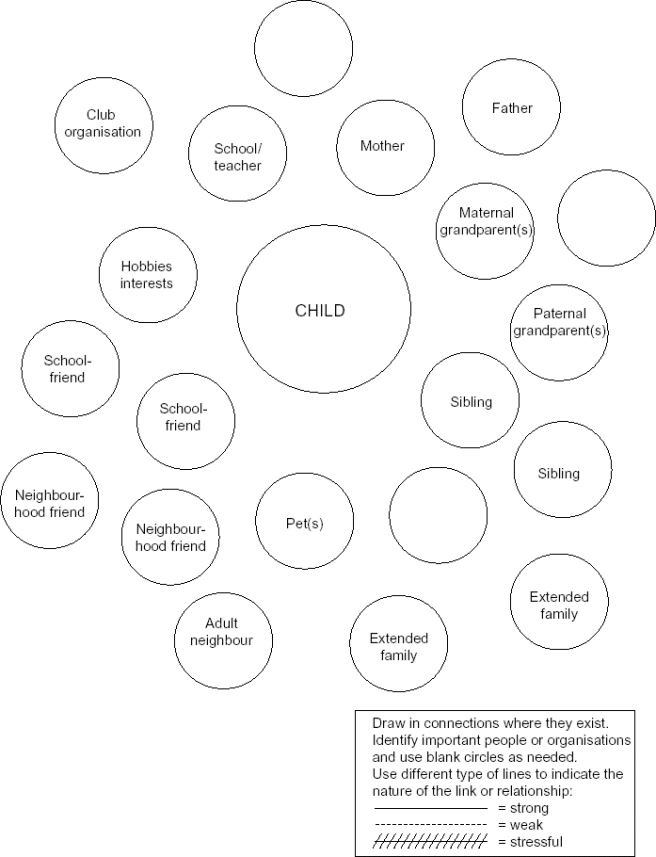
Further study
Brown, H and Smith, H (eds)
1992, Normalisation – a Reader for the Nineties, Routledge.
Department of Health, 1989,
An Introduction to the Children Act , HMSO.
Department of Health, 1991,
Care Management and Assessment – Practitioners Guide, HMSO.
Department of Health, 1980,
The Black Report – Inequalities in Health Care, HMSO.
Glendenning, C, 1983,
Unshared Care – Parents and their Disabled Children, Routledge.
Glendenning, C, 1986, A
Single Door: Social Work with Families of Disable Children, Allen and
Unwin.
Jenkins, J, Felce, D, Toogood,
S, Mansell, J, do Kock, U, 1988, Individual Program Planning, BIMH
Publications.
Kellmer-Pringle, M. 1974,
The Needs of Children, Hutchinson.
Oliver, M, 1990, The
Politics of Disablement, Macmillan.
Seigman, M, Darling, R, 1989,
Ordinary Families, Special Children, Guildford Press, New York.
Wilkin, D, Caring for
Mentally Handicapped Children, Croom Helm.
Wolfensberger, W, Thomas, S,
Passing – Normalisation Criteria and Ratings Manual, (2nd, edition),
1983, Canadian National Institute on Mental Retardation.
Woolfson, R, Children with
Special Needs: A Guide for Parents and Carers, 1991, Faber and Faber.
Other Publications which you
will find useful as sources of further reading include:
The Children Act 1989,
HMSO, London.
The Education Act 1981,
HMSO, London.
The Education Act (Special
Educational Needs) Regulations 1983, HMSO, London.
The Education Act 1993,
HMSO, London.
Warnock, M, 1978, Special
Educational Needs: Report of the Committee of Enquiry into the Education of
Handicapped Children and Young People, HMSO, London.
Ryan, J, and Thomas, F, 1980,
The Politics of Mental Handicap, Penguin.
Swain, J, Finkelstein, V,
French, S and Oliver, M, 1993, Disabling Barriers – Enabling Environments,
Open University/Sage.
Lyon, C, 1991, The
Implications of the Children Act 1989 on Children and Young People with
Severe Learning Difficulties, Barnardos.
The Children Act 1989 Guidance
and Regulations: Volume 6: Children with Disabilities, 1991, HMSO.
|