 |
SOCIAL CARE WITH CHILDREN AND FAMILIES Unit 2: Principles of Social Care with Children and Families UNIT OBJECTIVES After completing this unit you will be able to:
Session One
SESSION OBJECTIVES
After completing this session
you will be able to:
INTRODUCTION This first session will introduce you to the background in which social work with children and families takes place. It also provides a basis for you to explore some of the features of this work, and in particular the boundaries within which it takes place, and its inbuilt tensions. THE STATUTORY BACKGROUND If you had been a social worker with children and families in the 1950s and 1960s, you would have been very much a specialist children’s worker. You might have worked for a children’s charitable organisation such as Barnardo’s or the NSPCC, or you might have been employed by a local authority Children’s Department. The latter were set up in July 1948 following the implementation of the Children’s Act of that year. Other local authority social work services were carried out from health and welfare departments. In the 1970s and 1980s many
local authority social workers became more generic in their approach,
covering the needs of all clients. This followed the publication of the
Seebohm Report in July 1968, which proposed integrated personal social
services. The work of the previous Children’s Departments was subsumed under
the generic Social Services Departments, which came into being in England
and Wales in April 1971 with the implementation of the Local Authority
Social Services Act of 1970. In Scotland the newly set up Social Work
Departments also included probation services. In the 1990s there was a
move back to more specialist services concurrent with the implementation of
the 1989 Children Act and the 1990 Community Care Act. The new Diploma in
Social Work is designed with these developments in mind. Social workers are
seen to need a cluster of generic knowledge and skills, along with specific
knowledge and skills in a particular area of practice, for instance with
children and families.
THE POTENTIAL AND LIMITS OF SOCIAL WORK FOR CHILDREN AND FAMILIES When prospective social work students are asked why they want to be social workers, some say that they like working with people, or they want to help people. Others suggest they want to challenge the inequalities they have come across in their lives. Can social workers do both of these? What can they achieve, what should they try to achieve, and what are the limits or constraints on their work? As you move on to consider
these questions, you may find it helpful to bear in mind a general
definition of social work:
Social work is an accountable
professional activity which enables individuals, families and groups to
identify personal, social and environmental difficulties adversely affecting
them. Social work promotes social welfare and responds to wider social needs
promoting equal opportunities for every age, gender, sexual preference,
class, disability, race, culture and creed. Social work has the
responsibility to protect the vulnerable and exercise authority under
statute.
CCETSW: Rules and
Requirements for the Diploma in Social Work,
Paper 30 (Second Edition 1991), 1.1, p 8.
Now let’s look at some of these issues in more detail. Helping Karen to understand Karen may not need much help identifying what is wrong in her life. However, she may benefit from some assistance to understand what is happening, to put it into perspective, and to find ways of coping with or changing the situation. She may get all this from her friend, but a more neutral, confidential person may be able to provide some distance from the situation. She may or may not be able to share more of her feelings with someone she does not have to live alongside. Karen may see you as a friend, but there must be limitations to that relationship from your side. Helping Karen with her feelings It may be that Karen’s feelings about herself, about her former partner and other relationships are overwhelming her and affecting her more than she realises. She may need more professional help dealing with this, which you might provide directly or help her to find someone who could assist. Of course, her friend may notice this need, and suggest she sees her doctor. However, a busy doctor may just put her on antidepressants rather that provide her with the counselling that might be more helpful. The children, particularly Andy, may benefit from someone to talk to in their own right. Helping Karen to change the situation Karen may be dealing with the problems of neighbours by ignoring it. She may have been to the housing office to ask them to do something about it, and a housing officer may be keeping an eye on the situation. However, she may be suffering in silence, or the council may not be doing anything about the harassment. You could help her to challenge the housing department to do something about the harassment or you could advocate on her behalf. She may benefit from similar support with Andy’s school, or she may be dealing with this herself. Community support It might be possible to enable some group support to be developed, for instance involving Karen, her next door neighbour and other women on the estate. This could enable them to explore ways of tackling harassment, and its links with racism and sexism. Some social workers are fully committed to helping the community to tackle some of these wider issues. Such community social work may be very beneficial to Karen and her family, directly or indirectly. However, these activities are less and less encouraged, particularly given the resource constraints within which departments have to work. All this contact would be on a voluntary basis, and it may be that Karen would not be seeking social work help. She may view social workers with suspicion, aware only that they can take the children away. It may be that she does not know that social workers could assist her more informally. This may be because your team is very separate from the community, either physically or in its approach. There is also, of course, the danger here of a hard-pressed, under-resourced social work team being tied up too heavily in statutory work, such as care and child protection. TENSIONS IN SOCIAL WORK WITH CHILDREN AND FAMILIES In situations like the one you
have just explored, social workers may be seen on the one hand as friendly,
supportive people and on the other as possessing the power to intervene in
the lives of families. You may be very conscious of such tensions in your
role, particularly in circumstances where you do have to make use of these
powers. Tensions in this context can cause strains, demands and
contradictions.
SUMMARY In this unit you have looked at how a specific rather than a general approach to social work might benefit children and their families, examined some of the potential of work in this area, and considered some of the tensions in your work. In the next unit you will go on to look at how you can work with children and families in an anti-oppressive way.
Session Two
SESSION OBJECTIVES
After completing this session
you will be able to:
Introduction
How you tackle and respond to
this session will depend on your perspective and social position. You may be
someone who has experienced or is experiencing oppression or you may feel
you have played your part in the oppression of other people at times.
Finding someone to share your thoughts with may be helpful to your learning
in the session.
OPPRESSION
I would like you to tackle this
topic by reading the following thoughts and then completing the activity
that follows.
If you are oppressed in any
way, But you may not only feel but
also know you are oppressed, and you won’t let them get you down.
If you are involved in the
oppression of others, Spend a few minutes thinking
about how you personally relate to these thoughts. First reactions are
important, so I suggest you quickly make a note of these. Then think more
deeply about what may be being said, and if necessary add to your notes.
When you feel you are ready, answer the following questions.
What does oppression mean
to you?
Who oppresses?
Who might be oppressed?
Comment
What does oppression
mean to you? Who oppresses? Who might be
oppressed? TACKLING OPPRESSION
How you might get involved in
tackling oppression will depend on whether you are the oppressed or part of
the oppression, and on how aware you are of your position. Some people might
argue that social work cannot be anything else but oppressive because it is
part of the way the state keeps people in order. Others argue that while
certain practices in social work are oppressive, these can be challenged by
working in ways that are empowering. Whatever your point of view, you need
to keep in mind that what you do may not be received in the way you intend.
In other words, the users of the service might find what you do as a social
worker is oppressive, even though you do not feel that you are being
oppressive either by your attitudes or your actions. The following situation study
is a brief example of the initial involvement of a social worker in the
life of a family for the first time. Think about the account carefully and
then answer the questions that follow it.
The social services
department receives a referral about the Collins family from a teacher at
the Briars Primary School. One of the teachers telephones to report the
school’s concern about Arlene Collins, aged nine, who has recently been
arriving at school in a rather unkempt state. Recently Arlene’s father,
who brings her to school, has himself appeared very depressed.
Things have not been going
well for the family lately. Since Arlene’s mum left last year, Mr Collins
knows he has let things go a bit. But he is doing his best for his
daughter. Arlene has not wanted to talk to anybody – she loves her dad but
still misses her mum.
The teacher is well-known in
the school for getting things done, and has a good relationship with the
local social worker, who has links with the school. The teacher asks the
social worker to become involved. The family has not come to the attention
of the social services before. The social worker decides to visit to see
what the problem is.
How might the school have
been oppressive?
How might the social
services as an organisation have been oppressive?
How might the social
worker have been oppressive?
Comment
The school
The following questions
highlight my own concerns about the role of the school.
Why did the school not talk to Mr Collins?
Would there have been a different approach if
Arlene’s mother was around?
Did anybody try and talk to the child herself?
Did the school and the social services share the
same uncritical view and collude with each others’ prejudices,
particularly on the basis of their good relationship?
Might what seems good to the professionals appear
to be collusive and overpowering from other perspectives?
Was any class or gender stereotyping or labelling
present in their discussion?
The social services
as an organisation
A social services
department should have set procedures for dealing with referrals and
these have to be followed fully whenever there is any question of
child protection. Following the critical conclusions of so many
official inquiries it is not surprising that some procedures have
been designed with the protection of departmental reputations in
mind. Whatever their origins, and however valid they are, such
procedures demonstrate the power and authority of social services.
However, they also curtail excessive misuse of power and authority.
The social services
department and the school are two very powerful institutions,
represented by potentially powerful professionals, which impact on
families. Combined, their power is immense. It also does not take
much to imagine other powerful institutions being involved in such a
situation, for example, the police and mental health services. The
potential for oppression is always present in these organisations,
through their policies and procedures and through the direct and
indirect actions of the people who work in them, whatever their
intentions.
The social worker
Social workers are
under pressure to follow agency policy and procedures, and may feel
somewhat burdened by this at times. Possible oppression might be
revealed by asking the following questions.
Did the social worker in this situation have to act
in the way she did?
Could she have helped the schoolteacher deal with
the situation herself, or at least have advised the teacher to
speak to the family about the referral first?
If there was any labelling or stereotyping going
on, did the social worker go along with it or omit to challenge
it?
How did she make contact with the family?
Did she expect certain behaviour because of
prejudice? Did she, perhaps, act on the belief that the man needed
particular help because he was a man? Philanthropy can itself be a
form of oppression.
Learning from this study
In considering this situation
study we have looked at a number of ways social work can be oppressive,
particularly when working with other agencies with similar potential for
oppression. The social worker, the social services department, the school
and the other agencies can collude in keeping people down. They can act
together to help maintain the status quo of divisions and inequality. They
can also exacerbate this by making sure that those who are being kept down
feel everything is their fault. In this way, the oppressed are blamed for
the oppression.
Pointers for anti-oppressive
practice
Despite the situation study you
have just explored, it would be wrong to conclude that social work is always
oppressive. Some of the questions raised suggest other approaches to social
work which are less oppressive, even within a potentially oppressive system. Re-read your response to the
previous activity, and my comments. Then write down three key points that
you feel social workers and agencies need to address to tackle oppression
in their practice.
Comment
Some of the lessons
for me are:
agencies need to work together, but not in ways
that collude against families
we need to be careful not to act upon our
assumptions or the assumptions of others
we, and the agencies we work with, need to develop
ways of directly communicating with the people we work with.
Defining anti-oppressive
practice
In Unit One, Session Six, I
described anti-racist approach to the family as: ‘… including both
culturally sensitive practice and challenging racism. It is not only
recognising the effects of racism on black people, but also doing something
about it. It is not only about understanding the lack of influence of black
people on the system but working to empower black people. For white social
workers, it is not only accepting that there are black perspectives on the
family, but working with black people to change the system’. Using this description as a
basis, produce a brief definition of anti-oppressive social work with
children and their families. You could do this by writing a short
paragraph explaining what you feel are the key components of
anti-oppressive practice.
Comment
My suggested
definition of anti-oppressive practice is that it:
includes both practice which is sensitive to the
needs, views, rights and wishes of children and families
challenges oppression in all its forms
acknowledges the effects of oppression on children
and families and also does something about it
appreciates the lack of influence of children and
families in the system and works to empower them
accepts that there are different perspectives on
the family, but works with children and families to change the
system.
DEVELOPING ANTI-OPPRESSIVE
PRACTICE
So far you have looked at
practice in general. However it is equally important to identify any issues
which you need to understand more fully as you develop your practice. Spend five minutes listing
the key issues you now want to understand more fully. Your list could be
in the form of questions to which you want to find answers.
Comment
You will have come up
with your own agenda for enquiry, but it could include some of the
following questions.
In what ways are social work and other powerful
agencies oppressive, especially if they are mainly white, often
male-dominated organisations?
To what extent do institutions such as schools,
social work agencies and others support a dominant ideology which
maintains inequality and oppression?
What is your own relationship to oppression and
anti-oppressive practice, as a black or white, male or female
social worker?
What is your personal agenda
for developing anti-racist practice? Write a list of key anti-oppressive
approaches you will now try to pursue in your future work with children
and families.
Comment
This needed to be a
very personal activity, but it may help you to review your list with
a colleague or supervisor. If this is not possible, the following
checklist might help you assess your response to the activity.
Will you recognise the need to discuss fully with
the children and families with whom you are working what is
happening and what you are doing?
Will you listen carefully to the views and wishes
of the people you are working with?
Will you avoid taking on the views and opinions of
other agencies or other professional workers without considering
whether there might be prejudice involved?
Will you find ways of working which build up
people’s confidence and empower them to act, avoiding approaches
which undermine their confidence and abilities?
Are you committed to challenging oppression in
organisations?
Will you find ways of understanding how people from
different groups and communities experience oppression, perhaps
through reading or discussion?
Summary
We have made a start in this
session on exploring the issues of oppression and anti-oppressive practice,
but there will always be a need to continue to explore what we think and
feel about oppression. The development of anti-oppressive practice is a
lifelong challenge, not a short-term project.
In the next session you will
have the opportunity of looking in some depth at partnership with family
members, an approach that is potentially empowering rather than oppressive.
Session Three
Session objectives
After completing this session
you will be able to:
UNDERSTANDING PARTNERSHIP
Partnership is frequently
referred to in social work circles, although the concept is not exclusive to
social work. It is a concept that everyone gives at least verbal assent to.
Partnership is also a key feature of the 1989 Children Act. But what does it
really mean?
Make a list of all the
things that the word partnership can mean. Then select from or add
to this list to draw up a definition of partnership with children and
families.
Comment
‘Partnership’ can
mean:
working together, collaboration
a business arrangement
sharing on an equal basis
having a common aim
having some common aims, but with own priorities.
When you move to
providing a definition of partnership suitable for social work
with children and families you need to ensure it takes into
account the following:
working together with family members to a common
agreed purpose
sharing decision-making
recognising and respecting different skills,
knowledge, resources, values, experiences, wishes and priorities,
but also:
recognising inequalities in power.
Put very simply, partnership in
social work means working alongside people rather than taking them over.
Let’s now consider in more
depth what partnership involves.
WORKING IN PARTNERSHIP
Working in partnership with
people in social work is not always easy. As a social worker you will become
involved in complex situations in which different people may have different
interests. Read the following situation
study and answer the questions that follow.
Sarah, now aged 15, was
adopted as a child by Anne and Roger, a professional couple who were
unable to have children of their own. Sarah has always known that she was
adopted, something positively acknowledged by the family. She has been
well cared for by Anne and Roger, she is doing well at school, and appears
a well-adjusted young woman.
Recently, for various
reasons, Sarah has become very concerned to find her birth mother. Her
adoptive parents, particularly Anne, are finding this very difficult and
rather threatening. Relationships in the family are becoming very
strained, and all three are feeling bad about what is happening. Roger has
suggested that they all talk the situation over with a social worker, and
reluctantly Anne and Sarah have agreed.
What do you think would be
the benefits of working in partnership with the family members in this
situation? What do you think would be
the possible consequences of not working in partnership with the family
members in this situation?
Comment
This is a very
difficult situation, which needs handling very sensitively. Here are
some suggestions.
The benefits of
partnership
Each member of the family can have their say about
the situation and express their own needs, even if everybody’s
wishes cannot be met.
Both Sarah and her parents retain some control of a
situation which may appear to them to be getting out of control.
The family is likely to remain the best environment
for Sarah for a number of years.
The parents are likely to know Sarah better than
any social worker could. They therefore have the potential to
support her in her resolving her present needs.
Partnership makes it easier to retain a perspective
which focuses on the needs and rights of Sarah and her family,
rather than on the problems.
Your approach could be a model for both Sarah and
her parents.
Possible
consequences of not working in partnership
You could be given too much say in the decisions,
permitting possible errors of judgement.
There would be a focus on problems rather than on
needs and rights.
The family might become dependent on you.
Some members of the family might feel aggrieved
that their wishes and needs were not heard.
PROBLEMS IN PARTNERSHIP
In this activity you have
looked at the benefits of working in partnership and the consequences of not
doing so in relation to Sarah and her adoptive family. However, if you were
the social worker taking a partnership approach with the family members, you
might also encounter problems. Let’s look at what these might be. Consider the following
variant on the previous situation study.
Sarah, now aged 15, was
adopted as a child by Anne and Roger, a professional couple who were
unable to have children of their own. Sarah did not find out she was
adopted until recently, when she discovered her birth certificate by
accident among some old papers. Her adoptive parents had not told her as a
young child, deciding they would tell her when the time was right.
Unfortunately, they had never found the right time until it was too late.
Sarah had been well cared for by Anne and Roger, she is doing well at
school, and appears a well-adjusted young woman. But now things are going
wrong. She has become very confused and all the trust she had with Anne
and Roger has disappeared. Her adoptive parents just cannot handle the
situation, and feel everything is going to pieces, including their
relationship with each other. Roger has become very withdrawn, and Anne is
seeing a social worker on the advice of her doctor.
What possible problems might
arise in your attempt to work in partnership with the family in this
situation? Spend five minutes or so thinking about this and noting down your
answers.
Comment
Your attempts might be
thwarted by:
Varying reactions to
your intervention
Roger may refuse to
discuss anything, or may just not be there when you call. The
‘absent’ male partner is a common occurrence in social work. Sarah
herself might not co-operate. Any of the family members could have a
distrust of social workers.
Conflicting needs
There may be conflict
between the needs of the family as a whole, to stay together as a
unit, and the needs of Sarah to find her birth mother. There may be
conflicts between the different needs of Sarah herself, to have a
restored relationship with her adoptive parents, and to seek her
birth mother. She may need her family even more, if her attempts to
find her origins go wrong.
Time constraints
The time needed to work
in partnership with this family may just not be available. Pressure
of other work may mean you can spend only very limited time on this
one case. Organisational priorities, for instance on child
protection, may particularly affect your time.
Deterioration in the
situation
If the situation at
home deteriorated to any great extent, (for instance Sarah might run
away from home and move in with a friend) the partnership approach
will come under great pressure as you try to maintain a working
relationship with both Sarah and the parents.
Power inequalities
You need to be aware of
the inequalities of power in any social work situation. My
definition of partnership gives particular recognition to this. It
involves not only the professional and statutory powers of social
workers, but also power inequalities related to race, gender and
class. Social workers cannot pretend that their clients have the
same power as they do. Nor should they rely on the belief that using
the power they do possess will necessarily bring about change.
I now want you to
consider the implications of what you have explored in this session
for your own practice.
PARTNERSHIP WITH FAMILY
MEMBERS: POINTERS TO GOOD PRACTICE Think of a particular
situation from your present or past work with children and families and
ask yourself:
Did I work in partnership
with all family members? How could I have improved my partnership
practice?
See if you can produce a
checklist of about six questions which will help you to apply a
partnership approach to your future practice.
Comment
This is my attempt at
a checklist.
Am I working
together with each relevant member of the family? Am I sure that I
have not missed out some members of the family who may be
relevant, (for example other children, members of the extended
family)? Am I listening to
the views, wishes and priorities of everybody involved? What skills,
knowledge and resources have I recognised in different family
members? Have I checked out
with the family members what objectives are shared between the
family and myself and what objectives are not shared? Am I and the
family working together to deal with the tensions between the
needs and concerns of different family members? Am I recognising
the inequalities of power in the situation, how am I addressing
these inequalities?
Later in this unit you will be
considering the issues involved in working in partnership with other
agencies. You also be looking at the meaning of partnership again in
relation to specific topics, for example children with special needs, later
in this module. Think of a situation in which
you didn’t work in partnership with a family as well as you now believe
you should have done. Then note down your answers to the following
questions.
What do you think
prevented you from working in partnership at the time? What would you now do
differently to ensure you did work in partnership in situations like
this?
Comment
Try and get the help of
a colleague in reviewing your response. If this is not possible, use
the following checklist as an aid.
Was there something in this situation that made
partnership particularly difficult?
Am I now more aware of the need to work in
partnership and of the things to avoid?
Have I now got a list of positive things to do to
work more in partnership with children and families?
In thinking about this situation, is there one key
thing I now want to focus on in my future practice?
Summary
In this session you have looked
at the meaning of partnership and at the case for working in partnership
with family members. You have also considered some of the problems of
partnership and created a checklist of pointers for good practice. In the
next session you will explore ways of focusing on people’s abilities and
resources when you adopt a partnership approach.
Session Four
Session objectives
After completing this session
you will be able to:
Introduction
In this session you will be
able to explore the importance of recognising the resources and positive
qualities of the children and families with whom you come in contact. A
useful starting point might be to look at how you view yourself.
Spend up to ten minutes
making two lists – one of your positive qualities; the other of your
negative ones. Then jot down what you
feel are the influences which have affected the way you view yourself.
Comment
Your answer will be
personal and unique to you. However, the following points are
intended to help you reflect on your response.
Sometimes it is difficult to decide if a particular
quality is positive or negative; it could be both, for example
being reserved.
Your view of yourself may or may not have depended
on your identity as a black or white woman or man, and on your
age, class, and sexual preference, and whether you are disabled or
non-disabled.
Much depends on your life chances.
If you were feeling low, you may have felt that you
had little to offer; but if you were feeling happy, you might have
felt more positive about yourself.
You may not want people to make up their minds
about you on the basis of your behaviour when you are down.
None of us has total responsibility for what we are
or what we feel we are.
The way in which we are treated by other people,
especially significant others, can have an enormous impact on our
feelings about ourselves.
Developing awareness of
ourselves can help prepare us for working with other people. Insights we
have gained about ourselves can inform our understanding of the way family
members view themselves. I now want to use a similar approach to explore the
experience of being a client.
BEING A CLIENT
From time to time in our lives
we are all clients of one service or another. We might be clients of a
solicitor, or of an insurance agent. We might be clients of an advice
service, for example, because we are in debt or because of relationship
difficulties. Most of us have had the experience of being clients of a
doctor, although we are then called patients. Comment
Here is my own list.
I felt:
timid, hurt, angry,
worthless, insulted.
I would like to have
felt:
confident, assertive,
valued, respected.
No one is ever at their
best when they need assistance of some sort, or when they are
feeling low. In this position we enter a power relationship, where
one person has something to give which we need, whether that be
advice, assistance, information or support of some kind. It is so
easy for both parties to slip into a giving and receiving
relationship, where the focus is on a problem or need rather than on
abilities or talents.
We have learned through
socialisation how to behave in such a client or patient relationship. The
adviser or doctor has also been trained to take on a specific role. Whatever
the origin of our behaviour we may all, consciously or unconsciously, be
taking on the roles expected of us. Let’s now look at how we can begin to
counter this.
Towards empowerment Think back to the
unsatisfactory experience you considered in the last activity, and briefly
note down how the adviser or doctor could have helped you to feel more
positive.
Comment
You will have thought
about changes specific to the situation you were in. Some of these
could have included:
listening more to your view of the situation
recognition of the problems and needs you have, but
balanced by a recognition of your positive qualities – seeing what
you have as much as what you do not have
respecting you more as a person rather than simply
as a client or patient
allowing you to make decisions for yourself.
If people are listened to and
recognised for their positive qualities and abilities, they may also be in a
position to make decisions for themselves. If advisers or doctors respect
people, they are more likely to work in a way that does not take away their
right to self-determination. They are likely to work in partnership and in
ways that empower people. We will be returning to these key values
throughout this unit.
BUILDING ON THE RESOURCES OF
SOCIAL WORK CLIENTS
You have seen how important for
your self-image it is to be seen for your abilities as well as your needs
and problems. You have also explored how you would like to be treated as the
client of a service. Let’s now look at how, as a social worker, you can
develop an approach that recognises people’s abilities and resources as well
as their needs and problems
Women and social work
At this point I want you to
focus on social work with women. However, I believe that good practice with
women is likely to also be good practice with children, young people and
men.
As well as being the main
providers, women are also the main recipients of social work services.
However, ‘… social work with women tends to revolve around “problem” areas
so that interaction with women is likely to be based on a professional/
client model where the woman is being guided, helped or even ‘cured’ by the
social worker’.
(Eve Brook and Ann Davis,
Women, the Family and Social Work, Tavistock, London, 1985, p 66) List three or four ways in
which you could counteract this attention to problem areas. Although you
are considering work with women, your points should also be suitable as
guides to good practice with all people.
Comment
Whether you are a man
or a woman yourself, your list may include:
recognising strengths
encouraging clients’ positive feelings about
themselves
recognising with them the context in which they
live their lives
enabling them to increase their self-confidence
enabling them to decide for themselves
sharing information with them
sharing skills them
enabling the development of resources together.
Assess your approach to
children and family members in relation to each of the points in
Activity 16. You could use a scale similar to the one in the learning
profile at the beginning of the unit. Compile a list of
practical ways by which you can improve on any weak points.
Aim to spend up to an hour
on this review activity.
Comment
It might help you to go
through the activity with a colleague or supervisor. If this is not
possible, I suggest you use the following checklist.
Will the points in my list really help me to focus
more on people’s abilities and resources?
Have I looked honestly at my own practice in
relation to these points?
Have I identified practical ways at improving my
practice?
When will I return to this activity to review
whether I am continuing to improve my practice?
Summary
In this session you have
considered the importance of taking a balanced view of clients and explored
what it might feel like to be the client of a service. You have also thought
about how focusing on people’s abilities and resources as well as their
needs and problems is the key to good social work practice. In the next
session we will move on to look at how you can apply some of these
principles to your work with children.
Session Five
Session objectives
After completing this session
you will be able to:
Introduction
‘Children should be seen and
not heard!’ This old proverb has often been followed by many parents,
teachers and other adults in the past. I guess, like all proverbs, it has an
element of truth; children can be particularly noisy and demanding at times,
but so can some adults. If, however, it is taken to mean that children have
nothing worth saying, or that they should have no say in decisions that
affect their lives, then we would all perhaps disagree.
In this session I will explore
the importance of listening to children as one of the key principles of good
social work practice.
THE RIGHT OF CHILDREN TO BE
LISTENED TO
Although we often talk about
people having rights, the fact that there are different types of rights is
often not recognised by people. However, it is important to distinguish:
human
rights recognised by international codes, such as the right to religious
freedom legal
rights, enshrined in the law of the land, for example the right to vote if
you are 18 or over. (Such rights can be amended from time to time by the
law-makers. One instance is the age of consent.) moral
rights which are not recognised specifically in the law or in any
international code, for example the right to a job.
Do you think that children
have the right to be listened to? If so, what sort of right is this?
Comment
Many people would argue
that children’s rights to be listened to is a human, legal and moral
right. Let’s look briefly at each:
Human rights
The United Nations
Convention on the Rights of the Child, Article 12, states the
position very clearly:
Parties shall
assure to the child who is capable of forming his or her own views
the right to express those views freely in all matters affecting
the child, the views of the child being given due weight in
accordance with the age and maturity of the child. For this purpose,
the child shall in particular be provided the opportunity to be
heard in any judicial and administrative proceedings affecting the
child, either directly, or through a representative or an
appropriate body, in a manner consistent with the procedural rules
of national law.
(See Peter Newell, ‘New
report highlights reforms needed to implement Convention’ in
ChildRight, November 1991, pp 17-20)
Legal rights
One of the general
principles of the 1989 Children Act recognises the importance of
‘the ascertainable wishes and feelings of the child concerned in the
light of his (sic) age and understanding’ (Section 1.3(a)). This is
followed through in the body of the Act, for example S.22(4)(a),
which states that it is the local authority’s duty, so far as is
reasonably practical, before making any decision in relation to a
child to ascertain the child’s wishes, and S.22(5)(a), which states
that the local authority must give due consideration to the child’s
age and understanding and wishes.
(See Carole
Perry-Jones, ‘But will they listen’, in ChildRight, December
1991, pp 16–18)
Moral rights
Most of the
organisations concerned with children will consider that children
have a moral right to be listened to as well as a legal right. For
example, you will see references to the rights of children to have a
voice in the National Association of Young People in Care (NAYPIC)
Charter of Rights for Young People in Care.
Being listened to as a child
When we look at matters of
principle it is often helpful to start from those individual experiences
which have in some way informed our personal perspectives.
As children, there were
probably times at home or at school when you were misunderstood or got into
trouble because your point of view was not appreciated. The chances are that
this was because you were not really listened to. Think of a situation
when, as a child, your point of view was not really listened to.
Note down:
how you felt in that
situation
what effect this could
have had on you in the longer term.
Then compare your notes
with the comment that follows.
Comment
Situations you could
have suggested include:
l l l l How did you feel in
that situation?
As a child you may have
may have experienced such treatment as a matter of course. You may
have felt very angry or hurt about this but you may not have been
able to recognise these feelings in yourself as such.
On the other hand, you
may have only occasionally been taken by surprise by adults not
listening to you. You may have been able to dismiss any incident as
not that important.
What effect did it have
in the longer term?
These incidents could
have helped you grow, determined to overcome the odds. But it is
more likely that your growth as an individual would have been, at
least temporarily, adversely affected. If you were misunderstood or
ignored not only because you were young, but also because you are
black, or female, or disabled, you might now be aware of the
multiplied damage to your self-image. I’d now like to move on to
understand the reasons why some adults do not give full attention to
children and why they do not try and understand a child’s point of
view.
Adults listening to children From your own experience,
make a list of reasons why some adults do not always listen to a child’s
point of view.
Comment
You could have
suggested some specific reasons:
they are tired or busy
the children do not really understand the situation
the child seems to be talking nonsense
the child goes on and on.
However, you may also have included some wider reasons:
the power hierarchy in a patriarchal society
beliefs that children should be kept in their place
prejudice against particular children
personality problems of individual adults
fear in adults of weakness or loss of control
oppressive behaviour towards female children,
linked to oppression of women
oppressive behaviour towards black people,
including children.
Some of these reasons suggest clear parallels between the relationship of
adults and children and between those who have power in our society and
those who do not. Children are not the only people in society not being
heard.
LISTENING TO THE VOICE OF THE
CHILD: POINTERS FOR PRACTICE
So far in this session, you
have explored your own thoughts and feelings about being listened to as a
child. To some extent, you will also have considered the consequences of not
being listened to. As a social worker you will be aware of the serious
consequences of children not being listened to. From time to time child-care
scandals come to light that vividly demonstrate the need to listen to
children. Enquiries into such scandals can prompt changes in the law or
procedures. They can also encourage the development of good practice.
In this unit, you are
building up your own personal list of pointers to good practice. In the
light of your personal insights and your growing understanding of the
rights of children to be listened to, make a list of your own pointers in
this area, as a social worker with children.
Comment
Check whether you
have addressed any of the following points. You could:
become clear about what the law says about
listening to children
continue to work at how, as an adult with power and
authority, you actively listen to children and respect their
points of view
develop an anti-oppressive approach to listening to
children
develop skills of communicating with children
work actively on hearing what children from
different cultures have to say
work actively on listening to children with
communication and learning disabilities
work with others to challenge policies and practice
that prevent children from being heard.
The last three points are, I
believe, particularly important. I hope that you now feel
committed to really listening to children in your future work, so that you
understand their points of view. In order to review your learning in this
session, I want you to construct an agenda for action for yourself.
Write down five or six
practical things you now want to do to ensure as a social worker you do
listen properly to children in the future.
Comment
If at all possible you
should discuss your agenda with your supervisor or a colleague, but
if this is not possible you can use the following points to help you
assess your response.
Are the points on my agenda going to make a
difference to the way I listen to children?
Are they points that I can really do something
about?
How will I be able to check that I am acting on
this agenda?
Summary
In this session you have
considered the important principle of listening to children and the effects
on a child of being listened to or being ignored. You have also reflected on
the rights of a child to be heard and explored examples of good practice in
listening to children. Not listening can have tragic consequences. Actively
listening to children needs to become an important part of your practice.
In the next session you will
explore another aspect of good practice in working with children and
families: working effectively with other agencies.
Session Six
Session objectives
After completing this session
you will be able to:
Introduction
So far in this unit we have
explored key principles for working directly with children and families. In
this session we will be looking at the notion of partnerships with other
agencies. It is important to forge these partnerships in order to work
effectively with and on behalf of children and their families.
FAMILY LINKS WITH DIFFERENT
AGENCIES
The children and families
themselves are usually the prime partners of social workers. But this is far
from the end of the story. Families do not exist in a vacuum entered only by
the social services. They are linked in different ways to different
organisations and agencies. We therefore need to look at how far we should
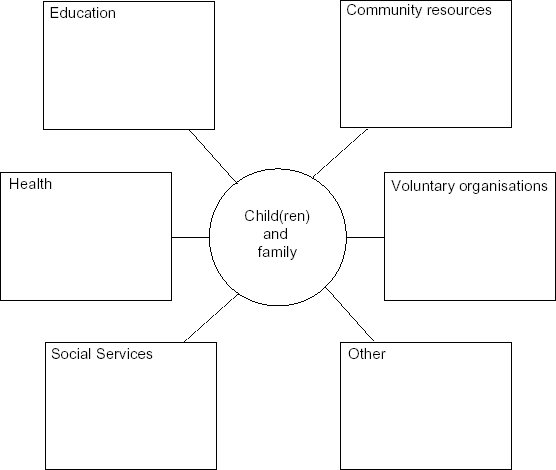
involve other organisations, agencies and community groups in partnership. On the diagram below, list
the different agencies with which children and families in need may be in
contact. Include both agencies with which any family might be in contact
with and also those agencies the family might come into contact with
because of need. Put an asterisk by such specialist organisations.
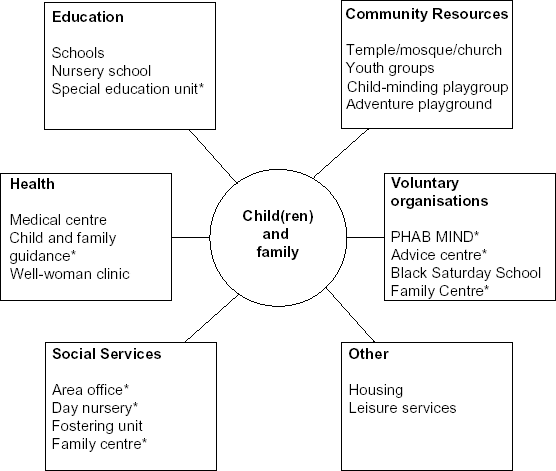
Comment
You can see from our
completed diagram overleaf that children in need and their families
have links with a number of specialised agencies, besides the more
general agencies with which all families are in contact.
I now want you to explore how you can work effectively in partnership with
these specialist agencies and organisations.
WORKING IN PARTNERSHIP WITH
OTHER AGENCIES
In Session Three you saw that
partnership included:
issues of working together, to a common purpose
recognising the different wishes, priorities, etc. of the various partners
recognising inequalities of power.
All these issues are relevant when we consider partnership with other
agencies. Below are two statements
about partnership with other agencies. Note down:
which
statement you think best indicates good practice
up to
six practical applications of the approach.
Partnership involves working
together with agencies and organisations in the community on behalf of
children and families.
Partnership involves working
together with agencies and organisations in the community alongside
children and families.
Comment
I hope you remembered
that our prime partners should be the children and their families.
It is vital to bear this in mind when you look at any partnership
you may have with agencies and organisations in the community. The
second statement therefore seems to be the most appropriate one.
Sometimes, however, you may need to work with agencies on behalf of
children and families. When this is the case your action needs to
taken where possible with the agreement and knowledge of the
children and the families.
Some practical
applications of this approach include:
gaining permission from the child and family to
speak to other agencies
enabling the child and the family to negotiate
directly with agencies and organisations, for example, through
facilitating meetings, providing resources and information
gaining permission from other agencies for
information provided by them to be available in open records;
ensuring that reasons are given, if information is not available
for the child and/or the family
enabling the child and the family to attend case
conferences, reviews and other relevant meetings and working with
other agencies to help them accept this participative approach
encouraging the child and/or family to gain support
and advice from another organisation such as a local advice centre
or an advocacy group such as Black Children in Care, NAYPIC,
Children’s Legal Centre
avoiding collusion between professionals.
In developing partnership with
other agencies, it is therefore always important to keep the child and the
family in mind and continue to work to empower rather than disempower them.
Making links with other
agencies
The 1989 Children Act stresses
the principle of partnership and requires local authorities, and therefore
social workers, to work together not only with children and families, but
also with other agencies (see Sections 17(5) (a) (b) and 27(2)). This
partnership will enable various authorities to provide an integrated service
and a range of resources. See the Legal Summaries, Units 2 and 3 of Using
the Law in Social Work and Units 7 and 8 of this module for more detailed
examination of the legal principles, provisions and practice of this aspect
of partnership. Co-operation between organisations, departments and
individual workers, working alongside children and families, is crucial to
the protection of vulnerable children. But how is all this to work in
practice? Let’s approach this by way of a situation study.
Mrs Mistry saw you as the
duty social worker to request a telephone, because her five-year-old
child Nilesh is having to make regular trips to a hospital, 30 miles
away, for treatment for a heart condition. She confirms that you may
contact the GP and the hospital to support the application.
On contacting the GP, you
find that she was on the verge of referring Mr and Mrs Mistry to the
social services department, suspecting neglect of Nilesh, since he had
missed three appointments for surgery to put in a cardiac catheter. This
operation is urgently needed and the delay may be endangering Nilesh’s
life. You consult with your senior and agree the need to:
check with central records about any previous social services
involvement
speak to the hospital to check out their view and concerns, and
whether a new appointment can be made
speak to the GP to check whether there are any other concerns about
Nilesh or his family and use this as a basis for carrying out a GP
register check
check with the school to see if they have any concerns.
List up to six points which
would guide you in carrying through these tasks in partnership with the
other agencies, the child and the family.
Comment
Some points which you
may have suggested include:
recognising that partnership is hard to implement,
especially when protection issues are present
not hiding behind the difficulties involved, to
avoid accountability to the Mistry family in dealing with other
agencies
avoiding going along with any judgemental
stereotyping from other agencies
informing the GP, hospital, schools, etc., that you
would want to share information they give to you with the child
and family if possible
checking with hospital about the possibility of not
booking an appointment without consulting the family
upholding Mr and Mrs Mistry’s parental
responsibility throughout
listening to Nilesh’s wishes and feelings.
Think of a family with
specific needs which you know.
Make a list of any
agencies you think this family would benefit from coming into contact
with. Select an agency from
the list and describe in two or three paragraphs how you could work in
partnership with the agency alongside the family.
Comment
It would be useful to
discuss your response with a colleague or supervisor, but if this is
not possible, you could assess your response by asking yourself the
following questions.
Have I been clear that the agencies will be helpful
to the family?
Have I described practical ways of working in
partnership rather than just hopes?
Have I kept in mind the need to work alongside the
family?
Summary
In this session you have looked
at the links between families with children in need and a variety of
different agencies and explored some of the issues of partnerships with
other agencies. Finally, you have reviewed some examples of good practice
for working in partnership with these agencies. In the next session you will
move on to look at the issues of care and control that arise in work with
children and families.
Session Seven
Session objectives
After completing this session
you will be able to:
Introduction
Social work, like education and
health services, is potentially a source both of control and liberation.
These sort of tensions are inherent in your role. In this session we will be
exploring the tensions between care and control, and finding ways of working
effectively within these tensions.
CARE AND CONTROL: THE TENSIONS
Care and control are key issues
in child care. They are also issues that you know about from experience,
either as a carer or as a child.
The term care is used in a
number of different ways. It can refer to a feeling, when we say we care
about someone. It can also refer to what we do for someone, when we say we
care for someone. The two meanings are linked: it would be difficult to care
appropriately for somebody if you did not care at all about her or him.
Control is not necessarily a
negative term. Many carers, particularly parents, see caring and controlling
as just different features of the love they have for their children. Sometimes carers feel they
need to convince the children that any controlling they do is because they
care. Consider your own experience of caring for children, or your
observations of other people caring for children.
In the first column below,
write down three controlling actions. In the second column, write down how
these actions might be justified in terms of caring.
Comment
Here are three suggestions for
comparison:
CARE AND CONTROL IN SOCIAL WORK
The last activity was concerned
with caring and controlling by parents or other carers. The situations in
which you need to control other people can likewise be linked to your care
about their welfare.
Although concerned specifically
about child protection, the Department of Health publication Protecting
Children has something useful to say about the tensions between care and
control in all social work with children and families:
Child protection work
inevitably involves the use of authority. Many practitioners remain
uncomfortable about openly acknowledging and using their authority in their
work with families … It has been argued that ‘care’ and ‘control’ are
opposing concepts and in the past this has led to different practitioners
taking what was a good role (i.e. offering support and counselling) or a bad
role (i.e. taking legal action); but it is now generally agreed that care
and control, as any parent knows, are part of the same process.
(DoH, Protecting Children,
HMSO, London 1988, p 11)
Many people enter social work
because they care about people and want to work them. Many social workers
are even called ‘care workers’. But social work does involve the use of
authority and control, and it is often said that social work is a method
of social control.
Note down two or three
examples from your own practice of how social work might be considered a
method of social control.
Comment
Typical situations in
which social control becomes an issue include:
investigation of a child abuse allegation
supervising a child or young person, or providing
supervised activities for children
writing a social work report for a court.
You may, of course,
have suggested other examples.
ADDRESSING THE TENSIONS BETWEEN
CARE AND CONTROL
As a social worker you may well
see yourself as a carer, and many of the people you work with may appreciate
the care you offer. However, many social work clients know very clearly
that, no matter how caring we are in our approach, we are still part of a
system of control. In certain circumstances we have a mandate to use
authority on behalf of society; and we cannot run away from that. What we
have to do is to find out how we can work effectively within the tensions
between care and control. This activity is designed to
enable you to identify ways of coming to terms with the tensions between
care and control.
Think of a situation in which
a child is being accommodated by the local authority because the child’s
parent(s) are temporarily prevented from providing suitable care. The
particular child is reluctant to go away from home, although this is
necessary. As the social worker you are aware that the child’s situation
could be exacerbated unless you can find appropriate accommodation, and
ensure the child remains there while the difficulties at home are sorted
out.
Spend ten minutes listing the
ways you might work effectively alongside the child and the family, within
the tensions of care and control.
Comment
Some possible ways
include:
accepting that these tensions exist
spending time with the child, demonstrating that
you are taking into account her or his wishes and feelings
keeping the child and the family informed at all
times
doing everything possible to work in partnership
with the child and the family (for example having parental support
for the placement)
involving the child, the family and the principal
carers in decision making
ensuring fostering or residential accommodation
takes account of the child’s race, religion, culture and language
having agreed and open recordings
establishing honest and open review processes.
In this way you are using the
authority you have in an open and honest way, and ensuring that you maintain
the key principles of practice you have been exploring in this unit. Working
according to such principles may be one way of managing the tensions between
care and control. Think of a particular
situation you have been involved with in your work with children and
families in which there were issues of control. Then:
make
an assessment of how you worked within these tensions
list
the points you would want to keep in mind in future work in this area.
Comment
You should if possible
discuss your response to this activity with a colleague or
supervisor. If this is not possible, I suggest you use the following
checklist to help you to assess your response.
Have I looked at my attitudes towards controlling
as well as my actions?
Have I acknowledged the real tensions involved in
social work with children and families?
Have I given myself clear guidelines for my future
practice?
Summary
In this session you have
explored some of the tensions between care and control and considered why
this tension occurs in social work with children and families. You have also
looked at ways of addressing these tensions. In the next, final session, you
will summarise your learning in this unit by developing a personal statement
of principles.
Session Eight
Session objectives
After completing this session
you will be able to:
REVIEWING YOUR LEARNING
You may have found this quite a
challenging unit. If so, I hope it has also been stimulating. You now need
to review what you have learned about principles of social work practice
with children and families. This will enable you to develop a personal
statement about your own principles. Look over the seven sessions
completed so far, and write a one-paragraph summary of each of the key
principles of practice as you see them. You should take time over this
exercise. I have completed one summary as an example.
The Potential and Limits of
Social Work with Children and Families Comment
Here are the rest of my
summaries.
Anti-oppressive Social
Work with Children and Families
Social work is not
immune from the rest of society’s oppression, and we have to have an
active determined anti-oppressive approach to our work. This demands
a critical analysis of both agency policies and practice and our own
attitudes and behaviour.
Partnership with Family
Members
Partnership with family
members is about working together to a common agreed purpose,
sharing decision-making, recognising and respecting different
skills, knowledge, resources, values, experiences, wishes and
priorities. With partnership, we can be more enabling and effective.
Without partnership, we can create dependence, undermine the people
we are working with and simply get it wrong.
Focusing on People’s
Abilities and Resources
From my own life
experience, I know how important it is to recognise what I can do as
well as what I can’t. Becoming a client can harm people. Social work
can be more effective if the focus is on people’s resources rather
than their problems. This focus is a prerequisite for social work
training which is enabling.
Listening to Children
Children are people
too, and have a right to be listened to and to have their views
taken into account, particularly when decisions are being made about
their future. Serious consequences can arise when children are not
listened to. As social workers, we need to develop skills in
listening to all children.
Partnership with Other
Agencies
Children and families
in need have links with many agencies and organisations. We may need
to work in partnership with many of these agencies, and it is
crucial in relation to child protection. However, partnership with
other agencies is not always easy to implement, and we must maintain
our partnership with the children and families at the same time.
Addressing Tensions
Between Care and Control
Although we might argue
that care and control can be part and parcel of the same thing, the
people we are working with may not see it that way. We have to
accept that, as social workers, we are involved in social control,
and we have to address the tensions between that and our motivation
to care. One way of doing this is to ensure we are working in line
with key principles of practice when using authority.
INTER-RELATIONSHIPS BETWEEN
PRINCIPLES
In looking at principles of
practice we need to avoid the danger of viewing each principle in isolation.
Different principles relate in some way to each other. For instance, in
Session Seven, we saw how maintaining other principles such as partnership
can help us address the tensions between care and control. Anti-oppressive
practice is one key principle which needs to be seen in the context of other
key principles. To practice in an anti-oppressive way needs to be our aim in
all situations.
It can be helpful to assign
particular guidelines for good practice to specific issues. For example, in
May 1989, The National Association of Probation Officers, NAPO, produced the
following set of guidelines for working with lesbians and gay men. Many of
their suggestions have a link with the sorts of principles we have
discussed, particularly in relation to anti-oppressive practice and social
control.
Homosexuality should be
seen as a legitimate sexual choice. No attempt should ever be
made to counsel lesbians and gay men out of their choice. Members should avoid
stereotyping and making offensive comments, and challenge them when they
are made – whether by clients or by colleagues. Offices should carry
information about available facilities for lesbian and gay men and this
information should be accessible to clients. Gay men and lesbians
should not be assumed to be deviant or inclined to law-breaking simply
because of their sexuality. In working with black
lesbians and gay men, members should be alert to the dual nature of the
discrimination they face in a racist and homophobic society. Sexual orientation should
not be referred to in reports or records unless it is relevant to the
offending behaviour and only then with the client’s permission, (unless
the offence makes it obvious). It should always be accompanied by
explanations of discrimination. Sexual orientation should
never be seen as a reason in itself for a recommendation for supervision
and attempts by courts to propose this should be resisted. Similarly, sexual
orientation should never to seen as a reason in itself for proposing
psychiatric reports or treatment and attempts by courts to do this should
be resisted. Lesbians and gay men
should not be considered unsuitable as parents on grounds of their sexual
orientation alone. Where supervision
includes work in relation to a client’s sexual orientation it should focus
on enabling them to contact appropriate resources and challenging
discrimination and negative images. A consideration of the
effects of heterosexism should be an integral part of all training
programmes. Section 28 of the Local
Government Act 1988 should not be allowed to inhibit services to lesbians
and gay men.
Make a note of any ways
you feel the NAPO guidelines could be improved. Suggest three or four
ways by which you could encourage anti-oppressive practice in your
workplace with lesbians and gay men.
Comment
Although I feel
these guidelines have much strength, the following improvements
could be made.
An additional point could be inserted that it
should not be assumed that every young person and adult we work
with is heterosexual.
Aspects of partnership could be addressed more
fully.
More could be said about focusing on gay and
lesbian people’s own resources.
You might be able
to encourage anti-oppressive practice by:
putting these guidelines on the agenda for
discussion at a staff meeting, or training session
actively developing positive images of gay men and
lesbian women as contributors to society, as colleagues and
customers
using these guidelines in your own practice
challenging oppressive practice in the workplace.
WORKING TO YOUR PRINCIPLES
Having a set of principles is
of very little value unless they are carried through into practice. Good
intentions are nothing without action.
Note down three or four
ways in which you could ensure that:
your statement of principles is relevant in the years to come
you
act according to those principles.
Comment
These are my
suggestions.
Be prepared to review your statement on a regular
basis, perhaps every six months, preferably in supervision.
Be willing to discuss your statement with other
people, perhaps with some of the children and families with whom
you work.
Be willing to completely rewrite your statement if
necessary.
Monitor your work with particular families against
your statement of principles.
Summary
In this session you have
reviewed your learning on issues of principle in social work with children
and families and produced your own statement of principles, with particular
reference to anti-oppressive practice.
Further Study
Here are some suggestions for
reading which will help you to follow up the main areas covered in this
unit.
Ahmad, Bandana, 1990, Black
Perspectives in Social Work, Venture Press, London.
Brook, Eve and Davis, Ann,
1985, Women, the Family and Social Work, Tavistock, London.
CCETSW, 1991, Rules and
Requirements for the Diploma in Social Work, Paper 30, (Second Edition).
Davis, H and Russel, P,
Physical and Mental Handicap in the Asian Community, National Children’s
Bureau.
DoH, 1988, Protecting
Children, HMSO.
Emecheta, Buchi, 1983,
Adah’s Story, Allison and Busby.
Forrester, Helen,1981,
Twopence to Cross the Mersey, Fontana.
Froggatt, Alison, 1987,
Family Work with Elderly People, BASW/Macmillan.
Horne, Michael, Values in
Social Work, Wildwood House.
Mullender, Audrey and Ward,
David, 1991, The Practice Principles of Self-Directed Groupwork:
Establishing a Value-Base for Empowerment, University of Nottingham
Department of Social Work.
NAPO, 1989, Working with
Lesbian and Gay Men as Clients of the Service: Good Practice Guidelines,
NAPO.
NAYPIC, Charter of Rights
for Young People in Care.
Newell, Peter, 1991, ‘New
report highlights reforms needed to implement Convention’, in ChildRight,
pp17-21.
Perry-Jones, Carole, 1991, ‘But
Will they Listen?’, in ChildRight, pp16-18. |
||||||||||||||||||||||||||||||||||||||||||||||||